As one of our commenters helpfully pointed out, we miscalculated the grade of The Orphans' Home Cycle II (Electric Boogaloo). Instead of being an A+, it should have been on the lower end of the A spectrum. This has been corrected in both the original post and the rankings for the year end best.
Read On »
Thursday, December 24, 2009

Tuesday, December 22, 2009
The Year's Best Reviewed Shows
An anniversary quietly passed a few weeks ago: Dec. 5 marked one year since we beta-launched Critic-O-Meter (though we'd been grading shows for a few months prior to build up our database and hone our methodology). Big plans are afoot for the future of the site--stay tuned for those--but for now we thought we'd harness the awesome power of our (sorted-by-hand) database to present you with a year-end list of the best-reviewed shows of 2009.
It's a surprising and fascinating cross-section of New York's best theater, if we may say so ourselves, and as much for what's included as for what isn't (sorry, Streetcar, too many dissenters to the crack the "A" list). The order below, though grouped by half-grades, reflects the ranking of the raw numbers (The Emperor Jones, for instance, rated a stronger A- than Jailbait).
Without further ado, two Footes, a pair of Souls, and other Krapp:
A
Click Clack Moo
Soul Samurai
Twelfth Night
Avenue Q (reopening)
The Norman Conquests
The Orphans Home Cycle, Part II
A/A-
Krapp, 39
A-
A Boy and His Soul
The Emperor Jones
Everyday Rapture
MilkMilkLemonade
The Lily's Revenge
Joe Turner's Come and Gone
My Wonderful Day
The Provenance of Beauty
The Orphans Home Cycle, Part I
Disfarmer
Jailbait
Mabou Mines Dollhouse
The Shipment
Bloody Bloody Andrew Jackson
Les Éphémères
County of Kings
Finian's Rainbow
The Last Cargo Cult
Ruined
Chautauqua
Pure Confidence
Groovaloo
God of Carnage
Circle Mirror Transformation
Fela!
The Late Christopher Bean
Ragtime (the one in Astoria, not the one on Broadway)
Speedmouse
Mary Stuart
Hair Read On »
It's a surprising and fascinating cross-section of New York's best theater, if we may say so ourselves, and as much for what's included as for what isn't (sorry, Streetcar, too many dissenters to the crack the "A" list). The order below, though grouped by half-grades, reflects the ranking of the raw numbers (The Emperor Jones, for instance, rated a stronger A- than Jailbait).
Without further ado, two Footes, a pair of Souls, and other Krapp:
A
Click Clack Moo
Soul Samurai
Twelfth Night
Avenue Q (reopening)
The Norman Conquests
The Orphans Home Cycle, Part II
A/A-
Krapp, 39
A-
A Boy and His Soul
The Emperor Jones
Everyday Rapture
MilkMilkLemonade
The Lily's Revenge
Joe Turner's Come and Gone
My Wonderful Day
The Provenance of Beauty
The Orphans Home Cycle, Part I
Disfarmer
Jailbait
Mabou Mines Dollhouse
The Shipment
Bloody Bloody Andrew Jackson
Les Éphémères
County of Kings
Finian's Rainbow
The Last Cargo Cult
Ruined
Chautauqua
Pure Confidence
Groovaloo
God of Carnage
Circle Mirror Transformation
Fela!
The Late Christopher Bean
Ragtime (the one in Astoria, not the one on Broadway)
Speedmouse
Mary Stuart
Hair Read On »
Saturday, December 19, 2009
The Orphans' Home Cycle (Part II)
GRADE: A

By Horton Foote. Directed by Michael Wilson. At the Signature Theater Through March 27th
Bigger really is better Off-Broadway this holiday season. With reviews ranging from an ecstatic A+ to a respectful B, the second installment of Horton Foote's The Orphans' Home Cycle has opened to universal acclaim for its staging and its 22-person cast, particularly lead Bill Heck and Horton Foote's daughter, Hallie. The sole complaint (which comes up in several reviews) is that, in trying to edit the nine plays in the cycle down to an hour each, the pieces feel a bit truncated and abrupt.
NY Daily News A+
(Joe Dziemianowicz) The real reason Foote's drama is so big and important is because it's so exquisitely realized — the writing, acting, direction and design. So far, it's a home run for its presenters, the Signature Theatre Company and Hartford Stage.
The Faster Times A+
(Jonathan Mandell) The three plays of “The Story of A Marriage” — “The Widow Claire,” “Courtship,” and “Valentine’s Day” — are in their plain underplayed way so engaging, so moving, that at several moments it can be hard to avoid the embarrassing spectacle of quietly crying in your seat at the Peter Norton Space of the Signature Theater Company. Beware of such a moment, for example, in the speech where the normally taciturn Horace finally opens up, saying lines like “I am no orphan, but I think of myself as an orphan, belonging to no one but you.”... Something extraordinary.
Wall Street Journal A+
(Terry Teachout) The second part of The Orphans' Home Cycle, Horton Foote's family album of plays about a turn-of-the-century Texas family and its struggles with the coming of modernity, has just opened at Signature Theatre Company. It upholds the immeasurably bright promise of the first installment. Not since Tom Stoppard's "The Coast of Utopia" has so self-evidently significant a large-scale theatrical endeavor come to New York.
TalkinBroadway A+
(Matthew Murray) “Intense” is not a word typically associated with the plays of Horton Foote. But when discussing the second chapter of the Signature Theatre Company’s production of The Orphans’ Home Cycle, none other will do. It’s not just that “The Story of a Marriage,” as it’s delightfully, deceptively titled, is riveting, though it is. Nor is it that it’s leaps and bounds better than the first part of the trilogy, which was already one of the finest evenings of theatre New York had seen in 2009, though against all odds it is. It’s that Foote has captured so many searing emotions and instances of raw-rubbing truth that this gone-in-a-blink three-hour outing isn’t at all about its ostensible subject, the ever-seeking Horace Robedaux (Bill Heck). It’s all about you.
North Jersey A
(Robert Feldberg) There were affecting moments in the first three plays, as young Horace moved around among relatives without complaint, but the works were uneven, and, since the leading character was essentially acted upon, somewhat lacking in drama....The plays are superbly acted by a large cast, and have been directed by Michael Wilson with uncommon sensitivity.
NYPost A
(Elisabeth Vincentelli) Rarely has everyday life been so modestly inspiring as it is in Foote's hands. The worst part is that we have to wait another month to see how it all ends.
Backstage A
(Erik Haagensen) Horton Foote's epic nine-play cycle about early-20th-century life in the small fictional town of Harrison, Texas, continues on its winning way. The three plays making up Part Two follow Horace Robedaux into his early adulthood, marriage, and incipient fatherhood, and there's not a wasted moment in them. As with Part One, three hours fly by as this utterly engaging and deeply compelling work unfolds.
On Off Broadway A
(Matt Windman) The Signature Theatre's noteworthy production, which presents the nine plays over three evenings, features 22 actors playing over 70 roles. Directed with cinematic finesse by Michael Wilson, the epic effort displays the gentle playwright at his very best. When other playwrights abandoned traditional storytelling in the mid-20th century, Foote devoted his writing to detailed, complex characters from the viewpoint of his Texas hometown....The entire cast is superb, especially Bill Heck as the forlorn but resilient Horace. But it is the playwright's daughter Hallie Foote, often considered the foremost interpreter of his work, who truly stands out in a wide variety of roles.
NYTimes B+
(Ben Brantley) Directed by Michael Wilson with assured understatement, and acted by a consistently convincing and versatile repertory cast, these plays flow with a sense of everyday life accelerated, moving by us in a blur of dramatic happenings lodged in the fine grit of the ordinary. The stories swapped here include tales of madness, alcoholism, suicide and deaths in childbirth.
Associate Press B+
(Michael Kuchwara) Horace Robedaux continues his journey into adulthood in Part 2 of "The Orphans' Home Cycle," Horton Foote's masterful examination of one man's life in small-town Texas in the first decades of the 20th century.
Theatermania B+
(Dan Bacalzo) There are moments in the script, particularly in Valentine's Day, that teeter on the brink of sentimentality. But Foote wisely undercuts this with a dark sense of humor, as well as a lingering sadness that makes whatever joy the characters experience seem, at best, bittersweet. Foote also includes some odd non-sequiturs in his dialogue that relieves the tension in certain moments, and provides several laughs, as well.
New Jersey Newsroom B
(Michael Sommers) Having written the nine full-length dramas in this cycle at various times during his career, Foote had virtually completed adapting them into hour-long versions for this new three-part epic when he died last March at the age of 92. A lurking suspicion that Foote may have edited his work somewhat too sharply is confirmed by viewing this second group of plays. People abruptly go off to events and improbably return even faster. Gossipy tales are whittled to their essentials.
GRADES:NYDN A+ 14; TFT A+ 14; WSJ A+ 14; TB A+ 14; NYP A 13; NJ A 13; BS A 13; OOB A 13; NYT B+ 11; AP B+ 11; TM B+ 11; NJNR B 10; TOTAL: 151/12 =12.58 (A)
Read On »

By Horton Foote. Directed by Michael Wilson. At the Signature Theater Through March 27th
Bigger really is better Off-Broadway this holiday season. With reviews ranging from an ecstatic A+ to a respectful B, the second installment of Horton Foote's The Orphans' Home Cycle has opened to universal acclaim for its staging and its 22-person cast, particularly lead Bill Heck and Horton Foote's daughter, Hallie. The sole complaint (which comes up in several reviews) is that, in trying to edit the nine plays in the cycle down to an hour each, the pieces feel a bit truncated and abrupt.
NY Daily News A+
(Joe Dziemianowicz) The real reason Foote's drama is so big and important is because it's so exquisitely realized — the writing, acting, direction and design. So far, it's a home run for its presenters, the Signature Theatre Company and Hartford Stage.
The Faster Times A+
(Jonathan Mandell) The three plays of “The Story of A Marriage” — “The Widow Claire,” “Courtship,” and “Valentine’s Day” — are in their plain underplayed way so engaging, so moving, that at several moments it can be hard to avoid the embarrassing spectacle of quietly crying in your seat at the Peter Norton Space of the Signature Theater Company. Beware of such a moment, for example, in the speech where the normally taciturn Horace finally opens up, saying lines like “I am no orphan, but I think of myself as an orphan, belonging to no one but you.”... Something extraordinary.
Wall Street Journal A+
(Terry Teachout) The second part of The Orphans' Home Cycle, Horton Foote's family album of plays about a turn-of-the-century Texas family and its struggles with the coming of modernity, has just opened at Signature Theatre Company. It upholds the immeasurably bright promise of the first installment. Not since Tom Stoppard's "The Coast of Utopia" has so self-evidently significant a large-scale theatrical endeavor come to New York.
TalkinBroadway A+
(Matthew Murray) “Intense” is not a word typically associated with the plays of Horton Foote. But when discussing the second chapter of the Signature Theatre Company’s production of The Orphans’ Home Cycle, none other will do. It’s not just that “The Story of a Marriage,” as it’s delightfully, deceptively titled, is riveting, though it is. Nor is it that it’s leaps and bounds better than the first part of the trilogy, which was already one of the finest evenings of theatre New York had seen in 2009, though against all odds it is. It’s that Foote has captured so many searing emotions and instances of raw-rubbing truth that this gone-in-a-blink three-hour outing isn’t at all about its ostensible subject, the ever-seeking Horace Robedaux (Bill Heck). It’s all about you.
North Jersey A
(Robert Feldberg) There were affecting moments in the first three plays, as young Horace moved around among relatives without complaint, but the works were uneven, and, since the leading character was essentially acted upon, somewhat lacking in drama....The plays are superbly acted by a large cast, and have been directed by Michael Wilson with uncommon sensitivity.
NYPost A
(Elisabeth Vincentelli) Rarely has everyday life been so modestly inspiring as it is in Foote's hands. The worst part is that we have to wait another month to see how it all ends.
Backstage A
(Erik Haagensen) Horton Foote's epic nine-play cycle about early-20th-century life in the small fictional town of Harrison, Texas, continues on its winning way. The three plays making up Part Two follow Horace Robedaux into his early adulthood, marriage, and incipient fatherhood, and there's not a wasted moment in them. As with Part One, three hours fly by as this utterly engaging and deeply compelling work unfolds.
On Off Broadway A
(Matt Windman) The Signature Theatre's noteworthy production, which presents the nine plays over three evenings, features 22 actors playing over 70 roles. Directed with cinematic finesse by Michael Wilson, the epic effort displays the gentle playwright at his very best. When other playwrights abandoned traditional storytelling in the mid-20th century, Foote devoted his writing to detailed, complex characters from the viewpoint of his Texas hometown....The entire cast is superb, especially Bill Heck as the forlorn but resilient Horace. But it is the playwright's daughter Hallie Foote, often considered the foremost interpreter of his work, who truly stands out in a wide variety of roles.
NYTimes B+
(Ben Brantley) Directed by Michael Wilson with assured understatement, and acted by a consistently convincing and versatile repertory cast, these plays flow with a sense of everyday life accelerated, moving by us in a blur of dramatic happenings lodged in the fine grit of the ordinary. The stories swapped here include tales of madness, alcoholism, suicide and deaths in childbirth.
Associate Press B+
(Michael Kuchwara) Horace Robedaux continues his journey into adulthood in Part 2 of "The Orphans' Home Cycle," Horton Foote's masterful examination of one man's life in small-town Texas in the first decades of the 20th century.
Theatermania B+
(Dan Bacalzo) There are moments in the script, particularly in Valentine's Day, that teeter on the brink of sentimentality. But Foote wisely undercuts this with a dark sense of humor, as well as a lingering sadness that makes whatever joy the characters experience seem, at best, bittersweet. Foote also includes some odd non-sequiturs in his dialogue that relieves the tension in certain moments, and provides several laughs, as well.
New Jersey Newsroom B
(Michael Sommers) Having written the nine full-length dramas in this cycle at various times during his career, Foote had virtually completed adapting them into hour-long versions for this new three-part epic when he died last March at the age of 92. A lurking suspicion that Foote may have edited his work somewhat too sharply is confirmed by viewing this second group of plays. People abruptly go off to events and improbably return even faster. Gossipy tales are whittled to their essentials.
GRADES:NYDN A+ 14; TFT A+ 14; WSJ A+ 14; TB A+ 14; NYP A 13; NJ A 13; BS A 13; OOB A 13; NYT B+ 11; AP B+ 11; TM B+ 11; NJNR B 10; TOTAL: 151/12 =12.58 (A)
Wednesday, December 16, 2009
The Great Recession
GRADE: C

By Various Authors. Directed by Various Directors. At the Flea. Through December 30th.
( UPDATE: Two late breaking reviews say pretty much the opposite of what you'll find in the rest of this paragraph, which was written based on the initial crop of negative reviews.) The Flea resorts to Off-Off Broadway's oldest trick in the ticket selling book, a night of somewhat interrelated short plays by various writers, ensuring larger casts with larger groups of friends needing to see the show while spending less money on labor than a full production with the same cast would cost. This being The Flea, the playwrights are heavy hitters-- Itamar Moses, Adam Rapp, Sheila Callaghan, Thomas Bradshaw and Will Eno-- and the actors are the Flea's non-union apprentice company The Bats. The directors (including Kip Fagan, Jim Simpson and Ethan McSweeney) are no slouches either. The theme is the economic crisis. The results, according to critics, are largely as these things always end up, intermittently entertaining but ultimately less than the sum of their parts. What's left for them to argue about is which shorts work and which don't, with no consensus favorites forming at all.
NYTheatre A
(David Ian Lee) Too often, festival presentations of one-acts play as hodgepodges of intermittently related material, with grievous shifts in tone and quality. Such is not the case with The Great Recession: the evening's connective tissue has been cultivated with fiendish wit and propinquity. Expedient scene shifts are shaped by character (and are sprinkled with good-natured nudity; this brilliantly serves the double purpose of inoculating the audience from the shock of flesh later bared for darker purposes), and though few of the actors appear in multiple roles, the ensemble feels as tight-knit as the tiniest of repertories. Indeed, when the full 50-plus person cast appears for their curtain call, there is additional awe and wonder in the uniformity and collective spirit of such a large company. As a parting salutation, the curtain call itself is staged with humility and genuine gratitude. The Great Recession earned a standing ovation the night I attended, though the production virtually necessitated one after this graceful, final touch.
The L Magazine A-
(Robert Tumas) With six shorts, none harps for too long on any one trope of stereotypically hard times and focus instead on the people involved in experiencing them. There are a few moments in the production that border on a sort of holiday nostalgia and sap that I could have probably done with out, but the total effect was absolutely captivating and left me wanting more. If the recession has affected you in any way, you must go see this play—and if nothing else, they sell Keystone Light cans for a dollar at intermission, so it's the cheapest beer in town.
Backstage B
(David Sheward) In terms of volume, "The Great Recession" is certainly a bargain. Sporting six one-act plays and a cast of more than 50, this program presented by the Flea Theater offers plenty to chew on, though some of the fare is definitely fast food. Played with great energy and specificity by the Bats, the Flea's resident company of young actors, the six plays are fast and furious snapshots of the effects of the world economic downturn. Some are funny and touching; a few are screeds of horror with all the subtlety of a sledgehammer.
Lighting & Sound America B-
(David Barbour) Somebody at the Flea Theatre -- probably Jim Simpson, the inventive artistic director -- had the idea of commissioning a batch of short plays tied to the current economic mess and its effect on today's young adults. It was probably inevitable that the resulting six-pack -- known as The Great Recession -- would be wildly uneven, but it has its moments, and it allows one to get a look at the theatre's talented young acting company, The Bats. The most successful plays are those that get at the theme in sideways fashion, rather than head-on... If The Great Recession is better in theory than in execution, it's an appealing idea, one that I hope the Flea will apply to other themes.
Time Out New York B-
(Adam Feldman)In his recent TONY interview, the monologuist Mike Daisey bemoaned the institutional slowness of American theater, and used the scarcity of responses to the financial crisis as an example of this problem. So the Flea Theatre’s Jim Simpson should be congratulated for corralling six of the city’s best rising playwrights to tackle the subject head-on in The Great Recession, a collection of playlets (each 15 to 20 minutes long) performed by three dozen members of the Bats, the Flea’s below-the-radar acting company...if this topical anthology isn’t always great, at least it is not recessive.
Theatermania C+
(Patrick Lee) For The Great Recession, currently at The Flea Theatre, six of theater's hippest playwrights were engaged to write short plays related to the current recession and its effects on young people. While some are more successful than others, the hit-or-miss evening doesn't cohere nearly as well as one would hope.
Variety C-
(Sam Thielman) Short play collections are always a mixed bag, but rarely are they as mixed as the Flea Theater's The Great Recession. Boasting some of Off Broadway's most popular writers, the anthology varies wildly in tone from dystopian dirge to cynical comedy. The best of the bunch are Will Eno's ruminative "Unum" and Thomas Bradshaw's hilariously biting "New York Living," both of which manage to mine new seams in the much-discussed terrain of the financial crisis.
NY Post D+
(Frank Scheck) Forget the economy. What this well-intentioned but shallow evening shows is that what theater really needs is an intellectual stimulus program.
The New York Times D
(Charles Isherwood) Writing to theme can be challenging, and most of the work here feels sketchy, unfocused or simply banal. Even “Unum” does not represent Mr. Eno, the talented author of “Thom Paine (based on nothing),” at his most inspired.
NYTH A 13; TLM A- 12; BS B 10; LSA B- 9; TONY B-9; TM C+ 8; V C- 6; NYP D+ 5; NYT D 4; TOTAL: 76/8 = 9.5 (B/B-)
Read On »

By Various Authors. Directed by Various Directors. At the Flea. Through December 30th.
( UPDATE: Two late breaking reviews say pretty much the opposite of what you'll find in the rest of this paragraph, which was written based on the initial crop of negative reviews.) The Flea resorts to Off-Off Broadway's oldest trick in the ticket selling book, a night of somewhat interrelated short plays by various writers, ensuring larger casts with larger groups of friends needing to see the show while spending less money on labor than a full production with the same cast would cost. This being The Flea, the playwrights are heavy hitters-- Itamar Moses, Adam Rapp, Sheila Callaghan, Thomas Bradshaw and Will Eno-- and the actors are the Flea's non-union apprentice company The Bats. The directors (including Kip Fagan, Jim Simpson and Ethan McSweeney) are no slouches either. The theme is the economic crisis. The results, according to critics, are largely as these things always end up, intermittently entertaining but ultimately less than the sum of their parts. What's left for them to argue about is which shorts work and which don't, with no consensus favorites forming at all.
NYTheatre A
(David Ian Lee) Too often, festival presentations of one-acts play as hodgepodges of intermittently related material, with grievous shifts in tone and quality. Such is not the case with The Great Recession: the evening's connective tissue has been cultivated with fiendish wit and propinquity. Expedient scene shifts are shaped by character (and are sprinkled with good-natured nudity; this brilliantly serves the double purpose of inoculating the audience from the shock of flesh later bared for darker purposes), and though few of the actors appear in multiple roles, the ensemble feels as tight-knit as the tiniest of repertories. Indeed, when the full 50-plus person cast appears for their curtain call, there is additional awe and wonder in the uniformity and collective spirit of such a large company. As a parting salutation, the curtain call itself is staged with humility and genuine gratitude. The Great Recession earned a standing ovation the night I attended, though the production virtually necessitated one after this graceful, final touch.
The L Magazine A-
(Robert Tumas) With six shorts, none harps for too long on any one trope of stereotypically hard times and focus instead on the people involved in experiencing them. There are a few moments in the production that border on a sort of holiday nostalgia and sap that I could have probably done with out, but the total effect was absolutely captivating and left me wanting more. If the recession has affected you in any way, you must go see this play—and if nothing else, they sell Keystone Light cans for a dollar at intermission, so it's the cheapest beer in town.
Backstage B
(David Sheward) In terms of volume, "The Great Recession" is certainly a bargain. Sporting six one-act plays and a cast of more than 50, this program presented by the Flea Theater offers plenty to chew on, though some of the fare is definitely fast food. Played with great energy and specificity by the Bats, the Flea's resident company of young actors, the six plays are fast and furious snapshots of the effects of the world economic downturn. Some are funny and touching; a few are screeds of horror with all the subtlety of a sledgehammer.
Lighting & Sound America B-
(David Barbour) Somebody at the Flea Theatre -- probably Jim Simpson, the inventive artistic director -- had the idea of commissioning a batch of short plays tied to the current economic mess and its effect on today's young adults. It was probably inevitable that the resulting six-pack -- known as The Great Recession -- would be wildly uneven, but it has its moments, and it allows one to get a look at the theatre's talented young acting company, The Bats. The most successful plays are those that get at the theme in sideways fashion, rather than head-on... If The Great Recession is better in theory than in execution, it's an appealing idea, one that I hope the Flea will apply to other themes.
Time Out New York B-
(Adam Feldman)In his recent TONY interview, the monologuist Mike Daisey bemoaned the institutional slowness of American theater, and used the scarcity of responses to the financial crisis as an example of this problem. So the Flea Theatre’s Jim Simpson should be congratulated for corralling six of the city’s best rising playwrights to tackle the subject head-on in The Great Recession, a collection of playlets (each 15 to 20 minutes long) performed by three dozen members of the Bats, the Flea’s below-the-radar acting company...if this topical anthology isn’t always great, at least it is not recessive.
Theatermania C+
(Patrick Lee) For The Great Recession, currently at The Flea Theatre, six of theater's hippest playwrights were engaged to write short plays related to the current recession and its effects on young people. While some are more successful than others, the hit-or-miss evening doesn't cohere nearly as well as one would hope.
Variety C-
(Sam Thielman) Short play collections are always a mixed bag, but rarely are they as mixed as the Flea Theater's The Great Recession. Boasting some of Off Broadway's most popular writers, the anthology varies wildly in tone from dystopian dirge to cynical comedy. The best of the bunch are Will Eno's ruminative "Unum" and Thomas Bradshaw's hilariously biting "New York Living," both of which manage to mine new seams in the much-discussed terrain of the financial crisis.
NY Post D+
(Frank Scheck) Forget the economy. What this well-intentioned but shallow evening shows is that what theater really needs is an intellectual stimulus program.
The New York Times D
(Charles Isherwood) Writing to theme can be challenging, and most of the work here feels sketchy, unfocused or simply banal. Even “Unum” does not represent Mr. Eno, the talented author of “Thom Paine (based on nothing),” at his most inspired.
NYTH A 13; TLM A- 12; BS B 10; LSA B- 9; TONY B-9; TM C+ 8; V C- 6; NYP D+ 5; NYT D 4; TOTAL: 76/8 = 9.5 (B/B-)
Monday, December 14, 2009
A Little Night Music
GRADE: B-
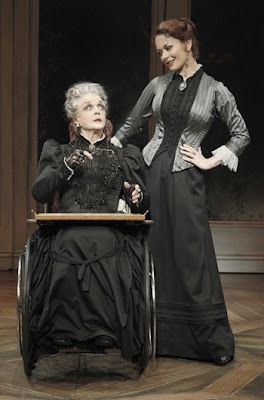
Photo by Joan Marcus
By Stephen Sondheim and Hugh Wheeler. Directed by Trevur Nunn. Walter Kerr Theatre.
Full-throated yea-sayers are in the minority for this long-overdue Broadway revival of Sondheim and Wheeler's frothy yet acerbic 1973 musical. Imported from an acclaimed chamber production at London's Menier Chocolate Factory, this Night Music acquired two marquee names along the way: Angela Lansbury, universally praised for her turn as Madame Armfeldt, and Catherine Zeta-Jones, unanimously lauded for her beauty but receiving mixed notices for her earthy take on Desiree, the middle-aged actress at the center of the action. Though a few critics find director Trevor Nunn's mix of stark design and broadly drawn characterizations sobering and provocative, most deplore both the somber sets and the exaggerated, even crude comic style of most of the cast aside from Lansbury, Zeta-Jones, and Alexander Hanson, as Fredrik. And nearly every critic slams the orchestra, a little for its playing (the tempi are apparently sluggish) and a lot for its size (a mere eight players!). For the record, two British papers also sent writers to cover the opening but we found them difficult to grade.
New York A
(Scott Brown) “Perpetual sunset,” the chorus sings, “is rather an unsettling thing.” So is this beautiful re-Bergmanized revival of Hugh Wheeler and Stephen Sondheim’s elegiac sex farce (based on Smiles of a Summer Night), with its restored Nordic tilt, its bracing draughts of carnal realpolitik, and its ghostly blue ache of some-requited love...Lansbury, who capsizes the theater with every roll of those outsize eyes, hurls mots from her throne like thunderbolts—not a single line lands askew. ALNM is among Sondheim’s near-perfect creations, but it’s not without its challenges, over and above the complexity of the music: Maunder overmuch and the show’s a drag; shine up the comedy and it risks coming off as a yuppie you-can-have-it-all manifesto. Maintaining that balance is the job of Desiree and Frederik, and Zeta-Jones—a tremendous presence here, in great voice—mates up with Hanson perfectly.
New Jersey Newsroom A-
(Michael Sommers) Looking as elegant as the musical she graces, Catherine Zeta-Jones makes a smashing Broadway debut in a wistful revival of "A Little Night Music"...A sophisticated musical in every respect — don't take anyone under the age of, say, 30 — "A Little Night Music" boasts a wry, well-turned text by Hugh Wheeler and an exceptionally lovely score by Stephen Sondheim that wafts the bittersweet story along in lilting waltz time...Staged more as a rueful comedy with music, this show unfolds quietly against a flexible setting of duskily mirrored panels that later opens to disclose a modest view of birch trees...Zeta-Jones is handsomely partnered by Hanson, a British actor also making his Broadway debut...Scarcely a dancing show in spite of its waltzes, the production moves smoothly at a leisurely pace that allows one to savor the words, music and evolving mix of emotions...Not everyone will enjoy the deliberate moodiness of this revival. Still, like the black gown Lansbury initially wears — gleaming with tiny brilliants on its bodice — the pensive quality suffusing Nunn's low-keyed production serves admirably as a background for a wonderfully iridescent score and a thoroughly adult story.
Backstage A-
(Erik Haagensen) A persuasive and entertaining account of a great American musical. The show runs longer this time around, a good three hours, due to the wealth of subtext being played in the scenes and slower tempos for the songs. The pace may be more deliberate, but the acting is richer, and interest never flags. One dividend is the attention being paid to Sondheim's phenomenal lyrics: I have never heard them get more laughs than in this production, aided by Jason Carr's elegant and supportive eight-piece re-orchestration. The generally excellent company is led by three top-flight performances...Zeta-Jones zeroes in on the fun Desiree and Fredrik had with each other during their affair. It makes for a unique and memorable creation...Alexander Hanson is every inch her equal...Angela Lansbury is enjoying another late-career triumph...Moments such as the soaring finish of "A Weekend in the Country" may not pack as much punch due to the reduced circumstances, but there are plenty of countervailing new pleasures to be found in Nunn's thoughtful take on this Broadway classic.
Theatermania A-
(David Finkle) Mostly effective...Catherine Zeta-Jones is even more beautiful in set-and-costume designer David Farley's Edwardian frocks and in the creamy flesh than she is on screen. Although her stage technique is still a bit rusty, and the role of frustrated actress Desiree Armfeldt is undoubtedly more complex than the song-and-dance parts she played in her earlier career, she does well by the play's pathos and wit...The reemergence of the tuner as a chamber musical...is a smart notion, well realized...No matter who's playing these comic figures immersed in their self-regard and unwitting buffoonery, the evening's heroes will always be Wheeler, who improved on the Bergman screenplay, and Sondheim, who in limiting his composing to 3/4 and 6/8 time rose to the challenge with some of his most beautiful and languorous melodies and some of his most consistently exquisite lyrics.
NY1 A-
(Roma Torre) Beautiful and deeply resonant, hitting every note with stunning honesty...Angela Lansbury's performance as Madame Armfeldt is magnificent. She nails her lines with the precision and killer timing that's likely to make her a contender for a sixth Tony Award. She also captures in Sondheim's music and Hugh Wheeler's book the overriding tone of the work -- a profound sense of longing, regret and sensuality. She is well-matched by Zeta-Jones, making a flawless Broadway debut with a performance that is also destined for a Tony nod...Her co-star Alexander Hanson, who originated the role of Desiree's former lover, lawyer Henrik Egerman in the London production fills out the starry trio with tremendous charisma and talent. Trevor Nunn's direction cut right to the soul of this work meticulously casting great voices all equally adept as actors...The show is long -- three hours with intermission and there are spots that could be cut. Too much of a good thing perhaps. But Sondheim being Sondheim, the virtues far outweigh the flaws.
USA Today B+
(Elysa Gardner) Lansbury, in an incandescent performance, lets us savor her haughty wit and see the fading but still defiant life force behind it. But Lansbury's is not the only marquee name in this production, or even the biggest. Catherine Zeta-Jones is cast as Night's true female lead, Madame Armfeldt's daughter Desiree, an actress facing middle age. The character is often played by older and less robustly sensual women; Zeta-Jones brings great warmth and vitality to the role and makes it easier to see why Desiree's old lover, Fredrik — the male lead, played with suave brio by Alexander Hanson — would vie with a blustering dragoon for her affections. Zeta-Jones is less effective, though, at suggesting Desiree's weary, rueful edges...This might owe something to Nunn's direction, as other performances here flirt with overzealousness...None of them, of course, blend wit and poignancy better than Lansbury — or Sondheim's score, for that matter. They are, without question, the two best reasons to see this revival.
Newsday B+
(Linda Winer) One of the most delectable musicals ever written, by Stephen Sondheim or anyone else. Angela Lansbury is giving a performance that deserves to be part of theater legend. Catherine Zeta-Jones is earthy and poignant in her confident Broadway debut. With all that, it is easier to live with—if not really forgive—the visual drabness and heavy hand of this gorgeous musical's first revival since its Tony-winning 1973 premiere. Director Trevor Nunn's skimpy production, conceived last year for London's tiny Menier Chocolate Factory, arrives with another of those scandalously reduced orchestras that Broadway producers try to pass off these days as innovation.
Financial Times B+
(Brendan Lemon) The intense pleasures of Sondheim’s wordplay and dazzling use of waltz time are expertly conveyed: Hanson and Catherine Zeta-Jones...bite off their lyrics with drilled precision. The roving lieder singers comment on the action with linguistic acumen. A distinct neither/nor quality, however, hovers in the atmosphere. The production is neither on the grand string-of-pearls scale of recent opera-house versions, nor of the one-bright-gem quality of recent chamber versions. The new, sometimes frustratingly dark Broadway set – smoked-mirrored panels in the first act, opening partially to birch trees in the second – is neither clever enough to embed the sophistication nor redolent enough to convey the summer-nights scenario. The costumes are lovely...The actors’ inability to flood the songs with emotional meaning makes the evening satisfying more than magical...Only Angela Lansbury, at 84 an old pro if ever there was one, is exactly where she should be at all times emotionally.
The Faster Times B+
(Jonathan Mandell) I understand some of the criticism. There are just eight members of the orchestra...The set consists mostly of a large wall that folds one way or another depending on the scene...In addition, the lighting is deliberately dark and the costumes lacking color, and some of the minor characters are directed to be broad and bawdy in ways that are at times distracting. Little of this dampens the experience for those of us who appreciate above all three (of course) elements of this production: Sondheim’s songs, Catherine Zeta-Jones’ allure, and Angela Lansbury’s majesty.
Variety B
(David Rooney) Director Trevor Nunn brings a blunt, heavy hand where a glissando touch is required, but the wit and sophistication of the material are sufficient to withstand even this phlegmatic staging. A handful of magnetic leads provides further insurance against the uneven production. At the center of that bright cluster is the luminous Catherine Zeta-Jones...Bewitching, confident and utterly natural, she breathes a refreshing earthiness and warm-blooded sensuality into the part...The production's real jewel is Angela Lansbury as her worldly mother...It's a marvelous role, and Lansbury's sublime performance in it alone makes this production unmissable. There's also a lovely three-generational throughline completed by the charming Keaton Whittaker's preternaturally intelligent Fredricka, who figures as Puck in this Scandinavian "Midsummer Night's Dream"...The monochromatic staging is further encumbered by stiff, presentational blocking that amplifies the operetta aspects but imposes a stodginess on the human drama, even when Nunn leans hard on the comedy...What's remarkable, given its unsatisfying elements, is that this "Night Music" still seduces.
Time Out NY B
(David Cote) Let’s get the bad news out of the way first. The orchestra is small, synthetic-sounding and weak; the set drab and dinky; and the pacing of songs often far too slow. Some cast members have been allowed to mug and simper for comic effect...On to good news: Catherine Zeta-Jones blazes with charisma, verve and wit as Desirée...If you’ve never seen a production of this romantic classic, by all means, go. The principals are suave and poised, and although Nunn seems to have encouraged them to sing their lyrics somewhat pedantically over the music, they sparkle and charm. Not to be missed is the venerable Lansbury putting her personal stamp on another Sondheim character. Alexander Hanson is a dashing figure, the sort of mature leading man we hardly ever see on Broadway. Would someone please steal his passport? Even so, let’s not expect the English to save Sondheim for us.
The Hollywood Reporter B
(Frank Scheck) Whatever its flaws, it's nonetheless a welcome return of a show that has inexplicably not received a Broadway revival since the original Hal Prince production in 1973...Nunn's minimalist approach contrasts sharply with Prince's original opulent staging, with mixed results. There will be many who bemoan the visually drab sets (largely composed of a large shifting wall and multiple mirrors) and monochromatic costumes, which add an unnecessary level of literal darkness to the proceedings. Even more painful to endure is the reduced, mere eight-piece orchestra which, despite the undeniably skillful orchestrations, simply doesn't do sufficient justice to Sondheim's magnificent, Tony-winning score. On the other hand, this intimate version does a wonderful job of accentuating the emotional complexities and endlessly witty dialogue of Hugh Wheeler's book, even if some of the overly broad performances by the supporting players threaten to overwhelm it. Zeta-Jones, younger than the performers who have traditionally played the role, is captivating as Desiree. The actress has musical theater experience, and it shows; she has terrific stage presence, unlike so many movie stars who tread the boards, and she sings and moves beautifully...Alexander Hanson, the sole carry-over from the London productions, is superb...Lansbury uses her well-honed theatrical instincts to perfect effect.
Lighting & Sound America B
(David Barbour) This melodic high comedy needs a high-style presentation, but style is a thing that comes and goes in Trevor Nunn's hot-and cold-running revival. Act I is enough to drive you to despair...Things improve markedly in Act II...Zeta-Jones relaxes into her role and strikes a real rapport with Alexander Hanson, the production's exemplary Frederik...Throughout the show's many ups and downs, Angela Lansbury's Madame Armfeldt remains in a class by herself...The rest of Nunn's production doesn't make the best case for an intimate staging of A Little Night Music. The pacing, particularly in Act I, is sluggish, and Jason Carr's cut-down orchestrations are a hit-or-miss affair...We don't get A Little Night Music so often that one can afford to ignore a major revival such as this. And, when Zeta-Jones and Hansen connect, or when Lansbury is working her magic, or when Sondheim's score takes flight, the show has its near-heavenly moments. But there's an element of style missing throughout.
New York Post B-
(Elisabeth Vincentelli) Lansbury's even better--if a tad too broadly comic--than in "Blithe Spirit," and it's a treat to hear her sing on Broadway for the first time since a short-lived "Mame" in 1983. Her "Liaisons" is a marvel of resourceful, inventive interpretation, lyric manglings be damned. But Madame Armfeldt is merely a supporting character. The star here is Zeta-Jones. She's radiant, yet doesn't shed much light on Desirée. Zeta-Jones is one of the few movie stars these days with golden-age Hollywood charisma...This is perfect for Desirée, who traffics in desire, but the character has more than one side. When she lets down her guard on the heartbreaking "Send in the Clowns," the fracture is unexpected here: Until then, we had no idea there were cracks under Zeta-Jones' breezy demeanor. But then Trevor Nunn's murky-looking production (did he and lighting designer Hartley T A Kemp take the "night" in the title literally?) isn't particularly subtle or graceful. Lacking both nuance and energy, it struggles to match the sophistication and gamesmanship of Sondheim's score, which evokes the effervescence of love, the abject pain it can cause, and the melancholy of its aftermath -- sometimes all in the same song.
Talkin' Broadway C+
(Matthew Murray) Catherine Zeta-Jones, as the famed actress Desirée Armfeldt, and Angela Lansbury, as Desirée’s mother, instinctively understand and project what Nunn and most of the rest of his cast do not: This show is not a turgid, angry tragedy, but a saucy lark that’s all about celebrating, as someone sensibly sings, “everything passing by"...Though Desirée is frequently portrayed as straight-up and stately, Zeta-Jones plays her as vivacity personified...Whereas Lansbury and Zeta-Jones land every lyric, line, and emotion, their castmates are lucky to eke out 65 percent most of the time. Hanson, who originated Fredrik in this production in London, is so stodgy and unappealing, it’s unclear why either Desirée or Anne would think twice of him...One suspects that Nunn is downplaying the show’s musical values in order to amplify its intimacy, which he practically confirms by so cranking down the tempos that most of the numbers barely step livelier than hangover slurring...Fortunately, this reconfiguring of the show’s basic nature is somewhat less harmful here than was the case in Nunn’s 2002 solemnizing of Oklahoma!. It’s still possible to have a good time.
The New York Times C
(Ben Brantley) A smirk shrouded in shadows. An elegiac darkness infuses this production...But the behavior of the characters who wander through a twilight labyrinth of passion in early-20th-century Sweden has the exaggerated gusto of second-tier boulevard farce, of people trying a little too hard for worldliness...In addition to being drop-dead gorgeous in David Farley’s wasp-waisted period dresses, Ms. Zeta-Jones brings a decent voice, a supple dancer’s body and a vulpine self-possession to her first appearance on Broadway...Her Desirée, to be honest, is much like her Velma: earthy, eager and a tad vulgar...Such traits lend a not always appropriate edge of desperation to the droll Desirée...Though Mr. Hanson turns in a suitably suave, measured performance as the middle-aged lawyer hoping to reclaim his youth, many of the other cast members exaggerate their characters’ defining traits to the bursting point...[The design's] somber, less-is-more approach could be effective were the ensemble plugged into the same rueful sensibility. But there is only one moment in this production when all its elements cohere perfectly...“Where’s discretion of the heart, where’s passion in the art, where’s craft?” Madame Armfeldt sings in lamentation. Looking at the production she appears in, I’d say she has a point.
Bloomberg News C
(John Simon) The show is based on one of Ingmar Bergman’s masterpieces, “Smiles of a Summer Night,” but the libretto that Hugh Wheeler adapted from it is little more than hack work. There is, though, Sondheim’s great score to balance things out...Lansbury is commanding as always, making Madame’s words, spoken and sung, resonate with multiple meanings...Zeta-Jones, on the other hand, is all artifice, whether in the play-within-the-play, in which Desiree is a notorious seductress, or offstage, when she is supposed to be her irresistible self. Words are delivered in a stilted rubato, oozing self-satisfaction, with affected facial expressions that are smug and patronizing...Alexander Hanson, a British import, is a persuasive, well-sung Egerman, sardonic, fatherly, boyish and mellow by judicious turns. Some other characters suffer from Nunn’s tendency to exaggerate the farcical...A mixed bag, then, made desirable by Sondheim’s music -- far from little and equally good for night and day.
The Daily News C
(Joe Dziemianowicz) Dim and downsized...It doesn't do justice to Stephen Sondheim's most elegant musical...Though the show is mostly well sung, the small orchestra sounds thin. The scenery recalls department store windows - nothing romantic in that. Sluggish pacing makes it feel like "A Lotta Night Music" and performances are too modern for a tale of romantic entanglements in late-19th century Scandinavia...Zeta-Jones, a London theater vet and an Oscar winner for "Chicago," knows her way around a stage and a musical. She looks ravishing, and although she's very emphatic in the show's famous number, "Send in the Clowns," she's got a pretty voice that serves her and the show well. But there's nothing world-weary about her Desiree to indicate she's ready to settle down...Also odd is Zeta-Jones' skittering accent, which wanders from Wales to mid-America to the Deep South.
Associated Press C-
(Michael Kuchwara) A curious affair. There are some lovely moments, most of them supplied by Angela Lansbury, but too much of this adult, sophisticated show, which opened Sunday at the Walter Kerr Theatre, seems forced, boisterous and a little crude...Zeta-Jones...is gorgeous, looking just right as this ripe, alluring woman who has never shirked from the way of all flesh. Zeta-Jones has a throaty, sensuous voice which she uses to good, flirty effect. But her acting, particularly in the first act, seems overdone, too strenuously self-aware...As Desiree's mother, the luminous Lansbury is a wonder...The aging process has never been more eloquently put on display...Hanson gives stalwart, gentlemanly support to the production's two leading ladies, and he plays Fredrik, the weary lawyer, with a just the right amount of knowing resignation...Where this production collapses is in the performances of the young people. True, they are supposed to be impetuous and, of course, foolish, but in this revival, Nunn has allowed them to become extravagantly cartoonish and unlikable.
Bergen Record D+
(Robert Feldberg) This gossamer, cynical look at love, based on Ingmar Bergman's 1955 film comedy "Smiles of a Summer Night," doesn't offer many points of emotional entrance...The mostly tiresome revival...doesn't give much reason for reappraisal...Rather than inducing a concentrated focus on the characters, the scenery is stifling, as well as bland...Whether at Nunn's behest, or on their own, many of the actors, including Zeta-Jones, work too hard to sell their characters. Even outfitted with a generic red wig, Zeta-Jones is a dazzling-looking woman. And playing Desiree Armfeldt, a celebrated actress who's had many lovers, she's amiable, amusing and exudes a very appealing lustiness...Making her Broadway debut, Zeta-Jones seems to feel the need to imprint her character on us. There are lots of over-animated facial expressions, and the frequent use of jagged gestures to punch home dialogue. You want to remind her of the old advice: Don't just do something. Stand there...Lansbury, playing Desiree's elderly, world-weary mother, delivers a sophisticated, delightfully piquant performance. So what else is new?
The Washington Post D
(Peter Marks) An actress radiating youthful vigor and sensuality is not a great fit for Desiree Armfeldt, the soignée Sondheim heroine whose most ravishing days are behind her. So it's an unfortunate truth that Catherine Zeta-Jones is not ideally cast as regretful, wistful Desiree in Trevor Nunn's virtually never-right revival of the suavely farcical "A Little Night Music"...When all is said and done, she is revealed as one of the less ill-suited elements of the production...The very best working part is five-time Tony winner Angela Lansbury...For this elegant Scandinavian roundel of amour, of foolish old lovers and foolish young lovers, of characters who couple for sex or for vanity or for an annuity, Nunn takes us on what feels like a cheap date.
New York A 13; New Jersey Newsroom A- 12; Backstage A- 12; Theatermania A- 12; NY1 A- 12; USA Today B+ 11; Newsday B+ 11; FT B+ 11; Faster Times B+ 11; Variety B 10; Time Out NY B 10; The Hollywood Reporter B 10; LS&A B 10; New York Post B- 9; Talkin' Broadway C+ 8; The New York Times C 7; Bloomberg News C 7; The Daily News C 7; Associated Press C- 6; Bergen Record D+ 5; The Washington Post D 4; TOTAL: 198/21=9.43 (B-)
Read On »

Photo by Joan Marcus
By Stephen Sondheim and Hugh Wheeler. Directed by Trevur Nunn. Walter Kerr Theatre.
Full-throated yea-sayers are in the minority for this long-overdue Broadway revival of Sondheim and Wheeler's frothy yet acerbic 1973 musical. Imported from an acclaimed chamber production at London's Menier Chocolate Factory, this Night Music acquired two marquee names along the way: Angela Lansbury, universally praised for her turn as Madame Armfeldt, and Catherine Zeta-Jones, unanimously lauded for her beauty but receiving mixed notices for her earthy take on Desiree, the middle-aged actress at the center of the action. Though a few critics find director Trevor Nunn's mix of stark design and broadly drawn characterizations sobering and provocative, most deplore both the somber sets and the exaggerated, even crude comic style of most of the cast aside from Lansbury, Zeta-Jones, and Alexander Hanson, as Fredrik. And nearly every critic slams the orchestra, a little for its playing (the tempi are apparently sluggish) and a lot for its size (a mere eight players!). For the record, two British papers also sent writers to cover the opening but we found them difficult to grade.
New York A
(Scott Brown) “Perpetual sunset,” the chorus sings, “is rather an unsettling thing.” So is this beautiful re-Bergmanized revival of Hugh Wheeler and Stephen Sondheim’s elegiac sex farce (based on Smiles of a Summer Night), with its restored Nordic tilt, its bracing draughts of carnal realpolitik, and its ghostly blue ache of some-requited love...Lansbury, who capsizes the theater with every roll of those outsize eyes, hurls mots from her throne like thunderbolts—not a single line lands askew. ALNM is among Sondheim’s near-perfect creations, but it’s not without its challenges, over and above the complexity of the music: Maunder overmuch and the show’s a drag; shine up the comedy and it risks coming off as a yuppie you-can-have-it-all manifesto. Maintaining that balance is the job of Desiree and Frederik, and Zeta-Jones—a tremendous presence here, in great voice—mates up with Hanson perfectly.
New Jersey Newsroom A-
(Michael Sommers) Looking as elegant as the musical she graces, Catherine Zeta-Jones makes a smashing Broadway debut in a wistful revival of "A Little Night Music"...A sophisticated musical in every respect — don't take anyone under the age of, say, 30 — "A Little Night Music" boasts a wry, well-turned text by Hugh Wheeler and an exceptionally lovely score by Stephen Sondheim that wafts the bittersweet story along in lilting waltz time...Staged more as a rueful comedy with music, this show unfolds quietly against a flexible setting of duskily mirrored panels that later opens to disclose a modest view of birch trees...Zeta-Jones is handsomely partnered by Hanson, a British actor also making his Broadway debut...Scarcely a dancing show in spite of its waltzes, the production moves smoothly at a leisurely pace that allows one to savor the words, music and evolving mix of emotions...Not everyone will enjoy the deliberate moodiness of this revival. Still, like the black gown Lansbury initially wears — gleaming with tiny brilliants on its bodice — the pensive quality suffusing Nunn's low-keyed production serves admirably as a background for a wonderfully iridescent score and a thoroughly adult story.
Backstage A-
(Erik Haagensen) A persuasive and entertaining account of a great American musical. The show runs longer this time around, a good three hours, due to the wealth of subtext being played in the scenes and slower tempos for the songs. The pace may be more deliberate, but the acting is richer, and interest never flags. One dividend is the attention being paid to Sondheim's phenomenal lyrics: I have never heard them get more laughs than in this production, aided by Jason Carr's elegant and supportive eight-piece re-orchestration. The generally excellent company is led by three top-flight performances...Zeta-Jones zeroes in on the fun Desiree and Fredrik had with each other during their affair. It makes for a unique and memorable creation...Alexander Hanson is every inch her equal...Angela Lansbury is enjoying another late-career triumph...Moments such as the soaring finish of "A Weekend in the Country" may not pack as much punch due to the reduced circumstances, but there are plenty of countervailing new pleasures to be found in Nunn's thoughtful take on this Broadway classic.
Theatermania A-
(David Finkle) Mostly effective...Catherine Zeta-Jones is even more beautiful in set-and-costume designer David Farley's Edwardian frocks and in the creamy flesh than she is on screen. Although her stage technique is still a bit rusty, and the role of frustrated actress Desiree Armfeldt is undoubtedly more complex than the song-and-dance parts she played in her earlier career, she does well by the play's pathos and wit...The reemergence of the tuner as a chamber musical...is a smart notion, well realized...No matter who's playing these comic figures immersed in their self-regard and unwitting buffoonery, the evening's heroes will always be Wheeler, who improved on the Bergman screenplay, and Sondheim, who in limiting his composing to 3/4 and 6/8 time rose to the challenge with some of his most beautiful and languorous melodies and some of his most consistently exquisite lyrics.
NY1 A-
(Roma Torre) Beautiful and deeply resonant, hitting every note with stunning honesty...Angela Lansbury's performance as Madame Armfeldt is magnificent. She nails her lines with the precision and killer timing that's likely to make her a contender for a sixth Tony Award. She also captures in Sondheim's music and Hugh Wheeler's book the overriding tone of the work -- a profound sense of longing, regret and sensuality. She is well-matched by Zeta-Jones, making a flawless Broadway debut with a performance that is also destined for a Tony nod...Her co-star Alexander Hanson, who originated the role of Desiree's former lover, lawyer Henrik Egerman in the London production fills out the starry trio with tremendous charisma and talent. Trevor Nunn's direction cut right to the soul of this work meticulously casting great voices all equally adept as actors...The show is long -- three hours with intermission and there are spots that could be cut. Too much of a good thing perhaps. But Sondheim being Sondheim, the virtues far outweigh the flaws.
USA Today B+
(Elysa Gardner) Lansbury, in an incandescent performance, lets us savor her haughty wit and see the fading but still defiant life force behind it. But Lansbury's is not the only marquee name in this production, or even the biggest. Catherine Zeta-Jones is cast as Night's true female lead, Madame Armfeldt's daughter Desiree, an actress facing middle age. The character is often played by older and less robustly sensual women; Zeta-Jones brings great warmth and vitality to the role and makes it easier to see why Desiree's old lover, Fredrik — the male lead, played with suave brio by Alexander Hanson — would vie with a blustering dragoon for her affections. Zeta-Jones is less effective, though, at suggesting Desiree's weary, rueful edges...This might owe something to Nunn's direction, as other performances here flirt with overzealousness...None of them, of course, blend wit and poignancy better than Lansbury — or Sondheim's score, for that matter. They are, without question, the two best reasons to see this revival.
Newsday B+
(Linda Winer) One of the most delectable musicals ever written, by Stephen Sondheim or anyone else. Angela Lansbury is giving a performance that deserves to be part of theater legend. Catherine Zeta-Jones is earthy and poignant in her confident Broadway debut. With all that, it is easier to live with—if not really forgive—the visual drabness and heavy hand of this gorgeous musical's first revival since its Tony-winning 1973 premiere. Director Trevor Nunn's skimpy production, conceived last year for London's tiny Menier Chocolate Factory, arrives with another of those scandalously reduced orchestras that Broadway producers try to pass off these days as innovation.
Financial Times B+
(Brendan Lemon) The intense pleasures of Sondheim’s wordplay and dazzling use of waltz time are expertly conveyed: Hanson and Catherine Zeta-Jones...bite off their lyrics with drilled precision. The roving lieder singers comment on the action with linguistic acumen. A distinct neither/nor quality, however, hovers in the atmosphere. The production is neither on the grand string-of-pearls scale of recent opera-house versions, nor of the one-bright-gem quality of recent chamber versions. The new, sometimes frustratingly dark Broadway set – smoked-mirrored panels in the first act, opening partially to birch trees in the second – is neither clever enough to embed the sophistication nor redolent enough to convey the summer-nights scenario. The costumes are lovely...The actors’ inability to flood the songs with emotional meaning makes the evening satisfying more than magical...Only Angela Lansbury, at 84 an old pro if ever there was one, is exactly where she should be at all times emotionally.
The Faster Times B+
(Jonathan Mandell) I understand some of the criticism. There are just eight members of the orchestra...The set consists mostly of a large wall that folds one way or another depending on the scene...In addition, the lighting is deliberately dark and the costumes lacking color, and some of the minor characters are directed to be broad and bawdy in ways that are at times distracting. Little of this dampens the experience for those of us who appreciate above all three (of course) elements of this production: Sondheim’s songs, Catherine Zeta-Jones’ allure, and Angela Lansbury’s majesty.
Variety B
(David Rooney) Director Trevor Nunn brings a blunt, heavy hand where a glissando touch is required, but the wit and sophistication of the material are sufficient to withstand even this phlegmatic staging. A handful of magnetic leads provides further insurance against the uneven production. At the center of that bright cluster is the luminous Catherine Zeta-Jones...Bewitching, confident and utterly natural, she breathes a refreshing earthiness and warm-blooded sensuality into the part...The production's real jewel is Angela Lansbury as her worldly mother...It's a marvelous role, and Lansbury's sublime performance in it alone makes this production unmissable. There's also a lovely three-generational throughline completed by the charming Keaton Whittaker's preternaturally intelligent Fredricka, who figures as Puck in this Scandinavian "Midsummer Night's Dream"...The monochromatic staging is further encumbered by stiff, presentational blocking that amplifies the operetta aspects but imposes a stodginess on the human drama, even when Nunn leans hard on the comedy...What's remarkable, given its unsatisfying elements, is that this "Night Music" still seduces.
Time Out NY B
(David Cote) Let’s get the bad news out of the way first. The orchestra is small, synthetic-sounding and weak; the set drab and dinky; and the pacing of songs often far too slow. Some cast members have been allowed to mug and simper for comic effect...On to good news: Catherine Zeta-Jones blazes with charisma, verve and wit as Desirée...If you’ve never seen a production of this romantic classic, by all means, go. The principals are suave and poised, and although Nunn seems to have encouraged them to sing their lyrics somewhat pedantically over the music, they sparkle and charm. Not to be missed is the venerable Lansbury putting her personal stamp on another Sondheim character. Alexander Hanson is a dashing figure, the sort of mature leading man we hardly ever see on Broadway. Would someone please steal his passport? Even so, let’s not expect the English to save Sondheim for us.
The Hollywood Reporter B
(Frank Scheck) Whatever its flaws, it's nonetheless a welcome return of a show that has inexplicably not received a Broadway revival since the original Hal Prince production in 1973...Nunn's minimalist approach contrasts sharply with Prince's original opulent staging, with mixed results. There will be many who bemoan the visually drab sets (largely composed of a large shifting wall and multiple mirrors) and monochromatic costumes, which add an unnecessary level of literal darkness to the proceedings. Even more painful to endure is the reduced, mere eight-piece orchestra which, despite the undeniably skillful orchestrations, simply doesn't do sufficient justice to Sondheim's magnificent, Tony-winning score. On the other hand, this intimate version does a wonderful job of accentuating the emotional complexities and endlessly witty dialogue of Hugh Wheeler's book, even if some of the overly broad performances by the supporting players threaten to overwhelm it. Zeta-Jones, younger than the performers who have traditionally played the role, is captivating as Desiree. The actress has musical theater experience, and it shows; she has terrific stage presence, unlike so many movie stars who tread the boards, and she sings and moves beautifully...Alexander Hanson, the sole carry-over from the London productions, is superb...Lansbury uses her well-honed theatrical instincts to perfect effect.
Lighting & Sound America B
(David Barbour) This melodic high comedy needs a high-style presentation, but style is a thing that comes and goes in Trevor Nunn's hot-and cold-running revival. Act I is enough to drive you to despair...Things improve markedly in Act II...Zeta-Jones relaxes into her role and strikes a real rapport with Alexander Hanson, the production's exemplary Frederik...Throughout the show's many ups and downs, Angela Lansbury's Madame Armfeldt remains in a class by herself...The rest of Nunn's production doesn't make the best case for an intimate staging of A Little Night Music. The pacing, particularly in Act I, is sluggish, and Jason Carr's cut-down orchestrations are a hit-or-miss affair...We don't get A Little Night Music so often that one can afford to ignore a major revival such as this. And, when Zeta-Jones and Hansen connect, or when Lansbury is working her magic, or when Sondheim's score takes flight, the show has its near-heavenly moments. But there's an element of style missing throughout.
New York Post B-
(Elisabeth Vincentelli) Lansbury's even better--if a tad too broadly comic--than in "Blithe Spirit," and it's a treat to hear her sing on Broadway for the first time since a short-lived "Mame" in 1983. Her "Liaisons" is a marvel of resourceful, inventive interpretation, lyric manglings be damned. But Madame Armfeldt is merely a supporting character. The star here is Zeta-Jones. She's radiant, yet doesn't shed much light on Desirée. Zeta-Jones is one of the few movie stars these days with golden-age Hollywood charisma...This is perfect for Desirée, who traffics in desire, but the character has more than one side. When she lets down her guard on the heartbreaking "Send in the Clowns," the fracture is unexpected here: Until then, we had no idea there were cracks under Zeta-Jones' breezy demeanor. But then Trevor Nunn's murky-looking production (did he and lighting designer Hartley T A Kemp take the "night" in the title literally?) isn't particularly subtle or graceful. Lacking both nuance and energy, it struggles to match the sophistication and gamesmanship of Sondheim's score, which evokes the effervescence of love, the abject pain it can cause, and the melancholy of its aftermath -- sometimes all in the same song.
Talkin' Broadway C+
(Matthew Murray) Catherine Zeta-Jones, as the famed actress Desirée Armfeldt, and Angela Lansbury, as Desirée’s mother, instinctively understand and project what Nunn and most of the rest of his cast do not: This show is not a turgid, angry tragedy, but a saucy lark that’s all about celebrating, as someone sensibly sings, “everything passing by"...Though Desirée is frequently portrayed as straight-up and stately, Zeta-Jones plays her as vivacity personified...Whereas Lansbury and Zeta-Jones land every lyric, line, and emotion, their castmates are lucky to eke out 65 percent most of the time. Hanson, who originated Fredrik in this production in London, is so stodgy and unappealing, it’s unclear why either Desirée or Anne would think twice of him...One suspects that Nunn is downplaying the show’s musical values in order to amplify its intimacy, which he practically confirms by so cranking down the tempos that most of the numbers barely step livelier than hangover slurring...Fortunately, this reconfiguring of the show’s basic nature is somewhat less harmful here than was the case in Nunn’s 2002 solemnizing of Oklahoma!. It’s still possible to have a good time.
The New York Times C
(Ben Brantley) A smirk shrouded in shadows. An elegiac darkness infuses this production...But the behavior of the characters who wander through a twilight labyrinth of passion in early-20th-century Sweden has the exaggerated gusto of second-tier boulevard farce, of people trying a little too hard for worldliness...In addition to being drop-dead gorgeous in David Farley’s wasp-waisted period dresses, Ms. Zeta-Jones brings a decent voice, a supple dancer’s body and a vulpine self-possession to her first appearance on Broadway...Her Desirée, to be honest, is much like her Velma: earthy, eager and a tad vulgar...Such traits lend a not always appropriate edge of desperation to the droll Desirée...Though Mr. Hanson turns in a suitably suave, measured performance as the middle-aged lawyer hoping to reclaim his youth, many of the other cast members exaggerate their characters’ defining traits to the bursting point...[The design's] somber, less-is-more approach could be effective were the ensemble plugged into the same rueful sensibility. But there is only one moment in this production when all its elements cohere perfectly...“Where’s discretion of the heart, where’s passion in the art, where’s craft?” Madame Armfeldt sings in lamentation. Looking at the production she appears in, I’d say she has a point.
Bloomberg News C
(John Simon) The show is based on one of Ingmar Bergman’s masterpieces, “Smiles of a Summer Night,” but the libretto that Hugh Wheeler adapted from it is little more than hack work. There is, though, Sondheim’s great score to balance things out...Lansbury is commanding as always, making Madame’s words, spoken and sung, resonate with multiple meanings...Zeta-Jones, on the other hand, is all artifice, whether in the play-within-the-play, in which Desiree is a notorious seductress, or offstage, when she is supposed to be her irresistible self. Words are delivered in a stilted rubato, oozing self-satisfaction, with affected facial expressions that are smug and patronizing...Alexander Hanson, a British import, is a persuasive, well-sung Egerman, sardonic, fatherly, boyish and mellow by judicious turns. Some other characters suffer from Nunn’s tendency to exaggerate the farcical...A mixed bag, then, made desirable by Sondheim’s music -- far from little and equally good for night and day.
The Daily News C
(Joe Dziemianowicz) Dim and downsized...It doesn't do justice to Stephen Sondheim's most elegant musical...Though the show is mostly well sung, the small orchestra sounds thin. The scenery recalls department store windows - nothing romantic in that. Sluggish pacing makes it feel like "A Lotta Night Music" and performances are too modern for a tale of romantic entanglements in late-19th century Scandinavia...Zeta-Jones, a London theater vet and an Oscar winner for "Chicago," knows her way around a stage and a musical. She looks ravishing, and although she's very emphatic in the show's famous number, "Send in the Clowns," she's got a pretty voice that serves her and the show well. But there's nothing world-weary about her Desiree to indicate she's ready to settle down...Also odd is Zeta-Jones' skittering accent, which wanders from Wales to mid-America to the Deep South.
Associated Press C-
(Michael Kuchwara) A curious affair. There are some lovely moments, most of them supplied by Angela Lansbury, but too much of this adult, sophisticated show, which opened Sunday at the Walter Kerr Theatre, seems forced, boisterous and a little crude...Zeta-Jones...is gorgeous, looking just right as this ripe, alluring woman who has never shirked from the way of all flesh. Zeta-Jones has a throaty, sensuous voice which she uses to good, flirty effect. But her acting, particularly in the first act, seems overdone, too strenuously self-aware...As Desiree's mother, the luminous Lansbury is a wonder...The aging process has never been more eloquently put on display...Hanson gives stalwart, gentlemanly support to the production's two leading ladies, and he plays Fredrik, the weary lawyer, with a just the right amount of knowing resignation...Where this production collapses is in the performances of the young people. True, they are supposed to be impetuous and, of course, foolish, but in this revival, Nunn has allowed them to become extravagantly cartoonish and unlikable.
Bergen Record D+
(Robert Feldberg) This gossamer, cynical look at love, based on Ingmar Bergman's 1955 film comedy "Smiles of a Summer Night," doesn't offer many points of emotional entrance...The mostly tiresome revival...doesn't give much reason for reappraisal...Rather than inducing a concentrated focus on the characters, the scenery is stifling, as well as bland...Whether at Nunn's behest, or on their own, many of the actors, including Zeta-Jones, work too hard to sell their characters. Even outfitted with a generic red wig, Zeta-Jones is a dazzling-looking woman. And playing Desiree Armfeldt, a celebrated actress who's had many lovers, she's amiable, amusing and exudes a very appealing lustiness...Making her Broadway debut, Zeta-Jones seems to feel the need to imprint her character on us. There are lots of over-animated facial expressions, and the frequent use of jagged gestures to punch home dialogue. You want to remind her of the old advice: Don't just do something. Stand there...Lansbury, playing Desiree's elderly, world-weary mother, delivers a sophisticated, delightfully piquant performance. So what else is new?
The Washington Post D
(Peter Marks) An actress radiating youthful vigor and sensuality is not a great fit for Desiree Armfeldt, the soignée Sondheim heroine whose most ravishing days are behind her. So it's an unfortunate truth that Catherine Zeta-Jones is not ideally cast as regretful, wistful Desiree in Trevor Nunn's virtually never-right revival of the suavely farcical "A Little Night Music"...When all is said and done, she is revealed as one of the less ill-suited elements of the production...The very best working part is five-time Tony winner Angela Lansbury...For this elegant Scandinavian roundel of amour, of foolish old lovers and foolish young lovers, of characters who couple for sex or for vanity or for an annuity, Nunn takes us on what feels like a cheap date.
New York A 13; New Jersey Newsroom A- 12; Backstage A- 12; Theatermania A- 12; NY1 A- 12; USA Today B+ 11; Newsday B+ 11; FT B+ 11; Faster Times B+ 11; Variety B 10; Time Out NY B 10; The Hollywood Reporter B 10; LS&A B 10; New York Post B- 9; Talkin' Broadway C+ 8; The New York Times C 7; Bloomberg News C 7; The Daily News C 7; Associated Press C- 6; Bergen Record D+ 5; The Washington Post D 4; TOTAL: 198/21=9.43 (B-)
Friday, December 11, 2009
Groovaloo
GRADE: A-
By Bradley Rapier, Danny Cistone and the Groovaloos, with additional material by Charlie Schmidt. Directed by Danny Cistone. Union Square Theater. (CLOSED)
Critics call Groovaloo a hip-hop A Chorus Line, as it takes a similar approach with dancers telling their stories (taken from the real-life stories of the company). Critics are entertained by the skilled dancers with the caveat that most of the stories are unoriginal. One story does stand out for them, that of Steven Stanton, who after being shot was told he'd never walk again, and uses his cane as a prop for his dances.
Backstage A
(Lisa Jo Sagolla) Regardless of your age or comfort level with new storytelling techniques and whitewashed hip-hop, you will assuredly relish the show's colorful, cartoonlike set by graffiti artist Toons One, the propulsive original music by a terrifically wide array of pop artists, and, most especially, the first-rate, frequently astonishing dancing. The young men deliver consistently superb solos of acrobatic floor work and imaginative freezes, the women are winningly fierce, and the ensemble choreography is excellent.
Nytheatre.com A
(Russell M. Kaplan) Actually, "impressive" is a pretty gross understatement for these guys: what they pull off with their bodies is at times unimaginable, as they seemingly defy gravity, space, or time like it was no big deal. Their solos and freestyle freakouts are so athletic and off-the-hook, that it's all the more astounding when they lock in with a group precision that implies a pack of funky robots tapped into the same mainframe. But robots they clearly are not. Humanity and truth are what elevate this show above an empty display of virtuosity, because these people really want us to understand why dance is such an important part of their lives. The themes of the dances tap into the members' insecurities as often as their joys: there's the ballerina who's too self-conscious to improvise, a few young dancers dealing with troubled family lives, and the near-fatal shooting of founding member Steven "Boogeyman" Stanton (who performs the bulk of the show with a cane).
Associated Press A
(Jennifer Farrar) All the dancers are excellent, irrepressibly bounding around the graffiti-painted, multilevel set with acrobatic zeal as they perform their own choreographed moves. Their varied styles include funk, head-spinning, lock-dancing (or popping) and many varieties of seemingly impossible somersaults and handstands. The infectious beat, supervised by Stanton and Rapier, is provided by original music from a number of artists, with additional sound design by Lucas Corrubia and Michael H.P. Viveros. Kinetic lighting design by Charlie Morrison blasts Laura Fine Hawkes' graffiti-painted set. Mora Stephens' colourful costumes give individuality to each dancer.
Talkin' Broadway A-
(Matthew Murray) Their stories all take on considerably more distinction once they actively kick up their heels - and most other imaginable body parts - to show that they practice what they preach. Numbers about the harrowing natures of auditions, living up to a father’s dreams (as represented in a challenge-tap mirror number), and making a warehouse lunch break far more musical than it has any right to be, are young, unpolished ideas. But they’re shiningly executed, and more than sufficient showcases for the undeniably talented cast to work out their coruscating kinetic vision of how to overcome life’s little obstacles. So dynamic are they, you wish the stereotypically graffiti-strewn set (Laura Fine Hawkes was the design consultant, Toons One the painter) and headache-inducing lighting (Charlie Morrison) represented as original a vision.
Variety B+
(Sam Thielman) The insta-inspirational plots frequently result in some stellar routines -- a couple of dancers (Jon Cruz and Oscar Orosco) start their duet with a been-done premise (a guy dancing with his reflection) but turn it into a great, multilevel competition that might be the show's highlight. It's tempting to say "Groovaloo" would be better if the performers just threw out the plot altogether and did routine after routine. But its lead creators (Bradley Rapier and director Danny Cistone) clearly believe the show's reason for being is to inspire people. The dancers are pretty impressive all by themselves -- who knew it was possible to spin on your head for that long and live to tell the tale? -- so one wonders what else Rapier and Cistone needed to prove.
TheaterMania C+
(Barbara & Scott Siegel) Conceived and created by Bradley Rapier and Danny Cistone, the show presents itself as a contemporary version of A Chorus Line with the performers dancing and telling their own stories, but the script falls somewhere between banal and pretentious. As much as it would like to inspire, it too often comes off as empty rhetoric and ignores an essential rule of writing: don't tell us, show us. (Most of the personal stories are recorded and told as voice-overs while the dancing happens onstage.)
Backstage A 13; Nytheatre.com A 13; AP A 13; Talkin' Broadway A- 12; Variety B+ 11; TheaterMania C+ 8; TOTAL: 70/6 = 11.67 (A-)
Read On »
By Bradley Rapier, Danny Cistone and the Groovaloos, with additional material by Charlie Schmidt. Directed by Danny Cistone. Union Square Theater. (CLOSED)
Critics call Groovaloo a hip-hop A Chorus Line, as it takes a similar approach with dancers telling their stories (taken from the real-life stories of the company). Critics are entertained by the skilled dancers with the caveat that most of the stories are unoriginal. One story does stand out for them, that of Steven Stanton, who after being shot was told he'd never walk again, and uses his cane as a prop for his dances.
Backstage A
(Lisa Jo Sagolla) Regardless of your age or comfort level with new storytelling techniques and whitewashed hip-hop, you will assuredly relish the show's colorful, cartoonlike set by graffiti artist Toons One, the propulsive original music by a terrifically wide array of pop artists, and, most especially, the first-rate, frequently astonishing dancing. The young men deliver consistently superb solos of acrobatic floor work and imaginative freezes, the women are winningly fierce, and the ensemble choreography is excellent.
Nytheatre.com A
(Russell M. Kaplan) Actually, "impressive" is a pretty gross understatement for these guys: what they pull off with their bodies is at times unimaginable, as they seemingly defy gravity, space, or time like it was no big deal. Their solos and freestyle freakouts are so athletic and off-the-hook, that it's all the more astounding when they lock in with a group precision that implies a pack of funky robots tapped into the same mainframe. But robots they clearly are not. Humanity and truth are what elevate this show above an empty display of virtuosity, because these people really want us to understand why dance is such an important part of their lives. The themes of the dances tap into the members' insecurities as often as their joys: there's the ballerina who's too self-conscious to improvise, a few young dancers dealing with troubled family lives, and the near-fatal shooting of founding member Steven "Boogeyman" Stanton (who performs the bulk of the show with a cane).
Associated Press A
(Jennifer Farrar) All the dancers are excellent, irrepressibly bounding around the graffiti-painted, multilevel set with acrobatic zeal as they perform their own choreographed moves. Their varied styles include funk, head-spinning, lock-dancing (or popping) and many varieties of seemingly impossible somersaults and handstands. The infectious beat, supervised by Stanton and Rapier, is provided by original music from a number of artists, with additional sound design by Lucas Corrubia and Michael H.P. Viveros. Kinetic lighting design by Charlie Morrison blasts Laura Fine Hawkes' graffiti-painted set. Mora Stephens' colourful costumes give individuality to each dancer.
Talkin' Broadway A-
(Matthew Murray) Their stories all take on considerably more distinction once they actively kick up their heels - and most other imaginable body parts - to show that they practice what they preach. Numbers about the harrowing natures of auditions, living up to a father’s dreams (as represented in a challenge-tap mirror number), and making a warehouse lunch break far more musical than it has any right to be, are young, unpolished ideas. But they’re shiningly executed, and more than sufficient showcases for the undeniably talented cast to work out their coruscating kinetic vision of how to overcome life’s little obstacles. So dynamic are they, you wish the stereotypically graffiti-strewn set (Laura Fine Hawkes was the design consultant, Toons One the painter) and headache-inducing lighting (Charlie Morrison) represented as original a vision.
Variety B+
(Sam Thielman) The insta-inspirational plots frequently result in some stellar routines -- a couple of dancers (Jon Cruz and Oscar Orosco) start their duet with a been-done premise (a guy dancing with his reflection) but turn it into a great, multilevel competition that might be the show's highlight. It's tempting to say "Groovaloo" would be better if the performers just threw out the plot altogether and did routine after routine. But its lead creators (Bradley Rapier and director Danny Cistone) clearly believe the show's reason for being is to inspire people. The dancers are pretty impressive all by themselves -- who knew it was possible to spin on your head for that long and live to tell the tale? -- so one wonders what else Rapier and Cistone needed to prove.
TheaterMania C+
(Barbara & Scott Siegel) Conceived and created by Bradley Rapier and Danny Cistone, the show presents itself as a contemporary version of A Chorus Line with the performers dancing and telling their own stories, but the script falls somewhere between banal and pretentious. As much as it would like to inspire, it too often comes off as empty rhetoric and ignores an essential rule of writing: don't tell us, show us. (Most of the personal stories are recorded and told as voice-overs while the dancing happens onstage.)
Backstage A 13; Nytheatre.com A 13; AP A 13; Talkin' Broadway A- 12; Variety B+ 11; TheaterMania C+ 8; TOTAL: 70/6 = 11.67 (A-)
Love's Labour's Lost
GRADE: B
By William Shakespeare. Directed by Dominic Dromgoole. Shakespeare's Globe Theatre at the Michael Schimmel Center. (CLOSED)
Critics are mixed on this, the first Globe import since Dominic Dromgoole took over the London theater from Mark Rylance: They agree that director Dromgoole has put the focus on the play's bawdy, headling farcical elements but don't universally feel that shows the play in its best light. Only the Times' Ben Brantley and the AP's Jennifer Farrar wholly embrace the show's manic, groundlings-geared sensibility as befitting the play's lustily youthful setting; the rest find the relentless high-jinks, though well-executed and often amusing, to be ultimately tiring or distracting. Critics are even mixed on which actors fare best, though Brantley makes a strong case for Michelle Terry's turn as the Princess of France.
The New York Times A
(Ben Brantley) Extravagantly funny...It is no insult to say that Dominic Dromgoole’s touring interpretation of Shakespeare’s comedy from the 1590s is sophomoric. On the contrary, Mr. Dromgoole, the artistic director of the London-based Globe, is to be commended for revealing that this word-infatuated frolic may well be the first and best example of a genre that would flourish in less sophisticated forms five centuries later: the college comedy...As the ensemble scampers merrily and distractedly in Elizabethan garb (occasionally venturing with charming disrespect into the audience), there’s a feeling of springtime headiness, of fresh sap rising...Mr. Dromgoole makes maximal use of the disparity between trained mind and animal instinct.
Associated Press A
(Jennifer Farrar) "Love's Labour's Lost" is one of Shakespeare's more complicated comedies, full of obscure literary references, wit and puns that could be confusing to a modern audience. Yet the lively, Elizabethan-style production currently at Pace University, who has partnered with Shakespeare's Globe Theatre of London, is so energetic and well-acted that its appeal transcends any possible issues of language. As directed by Dominic Dromgoole, the physical comedy in this lighthearted interpretation almost never stops...Combining witty banter with shameless mugging, comic antics and sprightly choreography, the ensemble has created a thoroughly joyous entertainment...Adorable stuffed deer puppets and charmingly period instruments, plied by an onstage troupe of live musicians, round out the feeling of being transported to the grounds of an Elizabethan castle.
Backstage B
(Leonard Jacobs) There is more farce and honest-to-God shtick than in a half-dozen Feydeau plays or the highest-octane Molière. Dromgoole, chiefly through Jonathan Fensom's design, transforms the stage of the Schimmel Center into something meant to approximate the wooden O that the Globe calls its London home. Instructing the actors to exhibit precision and alacrity, he also frees them to make mirth to excess. Allusions to sex are as rife and ribald visually as those found in the text...To the degree that "Love's Labour's Lost" is a purely rollicking, driving adventure, Dromgoole's foot remains hard on the pedal...Still, there comes a moment in this asthma-inducing production when one must ask if too much shtick is good for the play. It's audacious, yes, to overlay sight gags and physical comedy where the play's most poetic passages occur. But it comes at a price, constantly threatening to cheapen, if not overwhelm, Shakespeare's sweet sentiment. The audience is right to eat up all the high jinks, but they come too close to robbing us of the play's tender and rueful final message.
New York Post B-
(Frank Scheck) With its labyrinthine plotting and intellectual wordplay, "Love's Labour's Lost" is one of Shakespeare's less accessible comedies -- something London's Globe Theatre seems determined to change. Dominic Dromgoole's touring production accentuates the play's bawdy, rambunctious humor. There's so much physical shtick and in-your-face hijinks, the results resemble Shakespeare as filtered through Monty Python...There's no shortage of funny moments, and the ensemble delivers the archaic language with uncommon clarity. But the production stresses the humor to such a degree that it sacrifices emotion and characterizations.
Variety C+
(Marilyn Stasio) Dominic Dromgoole panders exclusively to modern-day groundlings. As an exhibition of low comedy, the show is notable for the cunning design and exhilarating execution of double entendres and vulgar sight gags. But it's thin gruel for more refined theatrical palates...Shakespeare conceived of his romantic comedy as a playful examination of the conundrum that faces all educated, well-born youth -- the delicious struggle between love and duty...But Dromgoole has so drastically restructured the romantic comedy that the royal players are robbed of their wit and reduced to the roles of rustics. And while the youthful performers gamely kick up their heels in stylized dances and athletic movement drills, all that kidding around eventually makes them look foolish.
Theatermania C
(Andy Propst) There's something charming about the freeness of this Shakespeare play, but in director Dominic Dromgoole's production, the quality is so over-emphasized that the piece becomes bewilderingly tedious. Indeed, audiences must endure too much physical comedy that inspires not guffaws, but incredulity...There are other pleasures to be found here, notably from set and costume designer Jonathn Fensom; his gorgeous scenic design mimics the configuration of the Elizabethan theaters and features handsomely painted drops that evoke the imagery of medieval tapestries. A host of fine secondary performances are also on view...Alas, these characters are too seldom at the fore of this labored production.
Nytheatre.com C
(David DelGrosso) Dromgoole's production succeeds in involving the audience and getting a lot of laughs, but this is largely done despite Shakespeare's comedy rather than with it...Instead of rising to the challenge of the play, the solution seems to be to aim low and add shtick. A lot of shtick...An exception to this problem is Paul Ready's portrayal of the Don Adriano De Armado...Ready grounds Armado in sincerity, and as a result I found him to be one of the most consistent and compelling characters in the play, and hilarious without seeming to try as hard to be as some of the other performers. Also good is Michelle Terry as the Princess of France...The rest of the characters, despite what seems to be a very skilled and energetic ensemble of actors, get largely washed out in a production so overloaded with general wackiness. Particularly lost is any chemistry between the romantic couples.
The New York Times A 13; Associated Press A 13; Backstage B 10; New York Post B- 9; Variety C+ 8; Theatermania C 7; Nytheatre C 7; TOTAL: 67/7=9.57 (B)
Read On »
By William Shakespeare. Directed by Dominic Dromgoole. Shakespeare's Globe Theatre at the Michael Schimmel Center. (CLOSED)
Critics are mixed on this, the first Globe import since Dominic Dromgoole took over the London theater from Mark Rylance: They agree that director Dromgoole has put the focus on the play's bawdy, headling farcical elements but don't universally feel that shows the play in its best light. Only the Times' Ben Brantley and the AP's Jennifer Farrar wholly embrace the show's manic, groundlings-geared sensibility as befitting the play's lustily youthful setting; the rest find the relentless high-jinks, though well-executed and often amusing, to be ultimately tiring or distracting. Critics are even mixed on which actors fare best, though Brantley makes a strong case for Michelle Terry's turn as the Princess of France.
The New York Times A
(Ben Brantley) Extravagantly funny...It is no insult to say that Dominic Dromgoole’s touring interpretation of Shakespeare’s comedy from the 1590s is sophomoric. On the contrary, Mr. Dromgoole, the artistic director of the London-based Globe, is to be commended for revealing that this word-infatuated frolic may well be the first and best example of a genre that would flourish in less sophisticated forms five centuries later: the college comedy...As the ensemble scampers merrily and distractedly in Elizabethan garb (occasionally venturing with charming disrespect into the audience), there’s a feeling of springtime headiness, of fresh sap rising...Mr. Dromgoole makes maximal use of the disparity between trained mind and animal instinct.
Associated Press A
(Jennifer Farrar) "Love's Labour's Lost" is one of Shakespeare's more complicated comedies, full of obscure literary references, wit and puns that could be confusing to a modern audience. Yet the lively, Elizabethan-style production currently at Pace University, who has partnered with Shakespeare's Globe Theatre of London, is so energetic and well-acted that its appeal transcends any possible issues of language. As directed by Dominic Dromgoole, the physical comedy in this lighthearted interpretation almost never stops...Combining witty banter with shameless mugging, comic antics and sprightly choreography, the ensemble has created a thoroughly joyous entertainment...Adorable stuffed deer puppets and charmingly period instruments, plied by an onstage troupe of live musicians, round out the feeling of being transported to the grounds of an Elizabethan castle.
Backstage B
(Leonard Jacobs) There is more farce and honest-to-God shtick than in a half-dozen Feydeau plays or the highest-octane Molière. Dromgoole, chiefly through Jonathan Fensom's design, transforms the stage of the Schimmel Center into something meant to approximate the wooden O that the Globe calls its London home. Instructing the actors to exhibit precision and alacrity, he also frees them to make mirth to excess. Allusions to sex are as rife and ribald visually as those found in the text...To the degree that "Love's Labour's Lost" is a purely rollicking, driving adventure, Dromgoole's foot remains hard on the pedal...Still, there comes a moment in this asthma-inducing production when one must ask if too much shtick is good for the play. It's audacious, yes, to overlay sight gags and physical comedy where the play's most poetic passages occur. But it comes at a price, constantly threatening to cheapen, if not overwhelm, Shakespeare's sweet sentiment. The audience is right to eat up all the high jinks, but they come too close to robbing us of the play's tender and rueful final message.
New York Post B-
(Frank Scheck) With its labyrinthine plotting and intellectual wordplay, "Love's Labour's Lost" is one of Shakespeare's less accessible comedies -- something London's Globe Theatre seems determined to change. Dominic Dromgoole's touring production accentuates the play's bawdy, rambunctious humor. There's so much physical shtick and in-your-face hijinks, the results resemble Shakespeare as filtered through Monty Python...There's no shortage of funny moments, and the ensemble delivers the archaic language with uncommon clarity. But the production stresses the humor to such a degree that it sacrifices emotion and characterizations.
Variety C+
(Marilyn Stasio) Dominic Dromgoole panders exclusively to modern-day groundlings. As an exhibition of low comedy, the show is notable for the cunning design and exhilarating execution of double entendres and vulgar sight gags. But it's thin gruel for more refined theatrical palates...Shakespeare conceived of his romantic comedy as a playful examination of the conundrum that faces all educated, well-born youth -- the delicious struggle between love and duty...But Dromgoole has so drastically restructured the romantic comedy that the royal players are robbed of their wit and reduced to the roles of rustics. And while the youthful performers gamely kick up their heels in stylized dances and athletic movement drills, all that kidding around eventually makes them look foolish.
Theatermania C
(Andy Propst) There's something charming about the freeness of this Shakespeare play, but in director Dominic Dromgoole's production, the quality is so over-emphasized that the piece becomes bewilderingly tedious. Indeed, audiences must endure too much physical comedy that inspires not guffaws, but incredulity...There are other pleasures to be found here, notably from set and costume designer Jonathn Fensom; his gorgeous scenic design mimics the configuration of the Elizabethan theaters and features handsomely painted drops that evoke the imagery of medieval tapestries. A host of fine secondary performances are also on view...Alas, these characters are too seldom at the fore of this labored production.
Nytheatre.com C
(David DelGrosso) Dromgoole's production succeeds in involving the audience and getting a lot of laughs, but this is largely done despite Shakespeare's comedy rather than with it...Instead of rising to the challenge of the play, the solution seems to be to aim low and add shtick. A lot of shtick...An exception to this problem is Paul Ready's portrayal of the Don Adriano De Armado...Ready grounds Armado in sincerity, and as a result I found him to be one of the most consistent and compelling characters in the play, and hilarious without seeming to try as hard to be as some of the other performers. Also good is Michelle Terry as the Princess of France...The rest of the characters, despite what seems to be a very skilled and energetic ensemble of actors, get largely washed out in a production so overloaded with general wackiness. Particularly lost is any chemistry between the romantic couples.
The New York Times A 13; Associated Press A 13; Backstage B 10; New York Post B- 9; Variety C+ 8; Theatermania C 7; Nytheatre C 7; TOTAL: 67/7=9.57 (B)
Fresh "Carnage"

Photo by Joan Marcus
Does Yasmina Reza's Tony-winning God of Carnage still rock without its stellar original cast? (Original post here.) Apart from Elisabeth Vincentelli at the New York Post, most critics give the new replacements a qualified yes, appreciating anew the play's merits (and flaws) and Matthew Warchus' direction, though splitting hairs over which new performances are best and which are less so. There are mostly kudos for the women, Christine Lahti and Annie Potts, replacing Marcia Gay Harden and Hope Davis, respectively (note: John Simon's review for Bloomberg News transposes the names). A few ding Jimmy Smits for his overly slick turn in the Jeff Daniels role, and there's some dissent on Ken Stott, a Scot who played the role in London but here has the unenviable task of filling James Gandolfini's Shrek-sized shoes. While the Daily News' Joe Dziemianowicz calls Stott "now the most compelling reason to see 'God of Carnage,' " the Bergen Record's Robert Feldberg finds his casting, and his pairing with Lahti, inexplicable and distracting, though he adds that the play "is still one of the smartest and most amusing evenings on Broadway."
Other critics may stop short of that encomium, but seem to agree that the show still works: John Simon at Bloomberg says it "still summons stentorian laughter from new audiences" but advises "would-be repeaters...to hold on to their memories." Theatermania's David Finkle (newly inducted into the New York Drama Critic's Circle, by the way) raves that the new actors are "just as hilariously and woundingly effective as their celebrated predecessors." And Talkin' Broadway's Matthew Murray, also a Stott fan, even thinks that "in spite of the ways it’s stumbled - just a little bit - God of Carnage is stronger for the difference" in casting. At the NY Times, Charles Isherwood reiterates some of his initial misgivings about the play, but pronounces that "the generally excellent new cast brings a slightly blunter edge to this primal rite" and that "under Matthew Warchus’s precise direction, the play definitely retains its appeal as a superficial but potent entertainment." Variety's David Rooney echoes Simon, writing that while the new God may not merit a revisit, "For those unable to score tickets during the mostly sold-out eight-month run, this undignified spectacle is most definitely still worth experiencing." From the headline, we guess that Newsday's Linda Winer seems to share the consensus ("Still amuses but less brutally"), but we can't be sure because her review is hidden behind a subscribers-only pay wall. Finally, for her part, Elisabeth Vincentelli at the Post writes that while the original cast "delivered hits with the precision -- and ruthlessness -- of champion fencers," with the new cast "the agility's gone, and the swords are blunted." Read On »
Wednesday, December 9, 2009
Brief Encounter
GRADE: B+

Photo by Pavel Antonov
Adapted and directed by Emma Rice (adapted from Noel Coward's Still Life and the screenplay Brief Encounter). St. Ann's Warehouse. Through Jan. 17.
Aside from Newsroom New Jersey's Michael Sommer, who has an affection for the source material, critics rave about Emma Rice's adaptation of Noel Coward's Brief Encounter. Many critics say this a perfect show for the holiday season and find themselves swept away by the blend of film projections, live action, vaudeville, puppets, and music. A few critics even dare to dream of a Broadway transfer. Note: Two more very negative reviews bring the grade down from an A to a B+.
The Daily News A+
(Joe Dziemianowicz) The most blissfully entertaining and inventive show in town isn't running on or off Broadway. Or anywhere near it, for that matter. It's in DUMBO at St. Ann's Warehouse, where "Brief Encounter" opened last night. Whatever gifts come my way at Christmas, none could make me smile more broadly or longer than this beautifully realized charmer by Britain's Kneehigh Theatre Company.
New York Post A+
(Elisabeth Vincentelli) Indeed, the director pulls every trick out of the theater playbook: The cast syncs up with projections (shot specifically for the show), supporting characters turn into a singing Greek chorus, actors occasionally sit down in the first row -- as if they were watching their own life unfurl. It's a rare case of a show in which form and content mesh seamlessly.
Variety A+
(Bob Verini) In the hands of Kneehigh doyenne Emma Rice, Rachmaninoff is kept to a minimum as subtext takes centerstage: Upon meeting, the swooning lovers fall backward into the empty arms of other cast members; a posh luncheon morphs into a sensual ballet, with heroine Laura (Hannah Yelland, in a deeply felt performance that brooks no mockery) dangling from a chandelier. Yet it all feels proper, as if Rice had merely turned the Coward fabric inside out to reveal its true essence... "Brief Encounter" is galvanized by ensemble energy. The tea girl (dazzling butterball Beverly Rudd) zooms about on a scooter to vamp cigarette boy Stanley (Stuart McLoughlin), while her boss (charming Annette McLaughlin) wiggles a padded bustle at dispatcher Albert (cheery Joseph Alessi, doubling as Laura's husband). The antics are most surrealist yet grounded in character reality.
Hollywood Reporter A+
(Frank Scheck) Upon entering the theater, you're greeted by movie-theater ushers in period garb who regale you with comic banter and musical numbers. This immersion continues with the show proper, which ingeniously incorporates old-style film images and projections that the characters pop in and out of with abandon. The overall effect is visually dazzling, but the neatest trick is that the technological gimmickry never overwhelms the simple power of the tale.
Newsday A+
(Linda Winer) If "Brief Encounter" is typical of Kneehigh's creations, the process makes a hearty combination of dark expressionism and cartoon delight. The show, which had a successful run in London's West End, includes enchanting sets and costumes that Neil Murray designed for touring. All the words come from Coward, but not all are from the movie. The versatile supporting players transform with larky ingenuity from tearoom staff in the train station to characters with their own individual drama. They are also there to catch Laura (the impeccable and luminescent Hannah Yelland) and Alec (the dashingly sympathetic Tristan Sturrock) as they are literally swept backward off their heels by passion.
Lighting & Sound America A+
(David Barbour) Emma Rice, who adapted and directed the stage version, pursues a risky, two-pronged approach. The scenes between Laura, the quiet, gentle housewife, and Alec, the doctor who falls desperately in love with her, are played with utter conviction, albeit with a pronounced patina of period style. Everyone else is amusingly caricatured, using every theatrical trick at the company's fingertips... According to all laws of the theatre, this should result in an unholy mess of knockabout comedy and soap opera emotions, a clash of tones that cancels everything out. Instead, Rice's methodology provides abundant amusement while casting the central story in a heightened, and remarkably moving, light. It also reveals something essential about Coward, a master entertainer who often packaged darker, more unpalatable truths inside his slick comedies and musicals. Later in life, Coward wrote a fan letter to Harold Pinter, expressing his fascination with how Pinter broke every rule of traditional theatre, "except to not bore the audience, even for a split second." My guess is he'd see what the Kneehigh Theatre is up to, and would wholeheartedly approve.
Backstage A
(Erik Haagensen) Adapter-director Emma Rice remains true to Coward's essence while enlivening the work with songs (some by Coward), film sequences, dance, and even puppets (representing Laura's children). Repeated episodes of stylized movement find a moving physical expression of societal constraints and emotional repression. Rachmaninoff's Piano Concerto No. 2, so important in the film, surges as scenes of crashing waves roll upstage. Interestingly, the text hews more closely to "Still Life" than the film, which is told in flashback, practically eliminates Beryl and Stanley, and cuts back on Myrtle and Albert in order to focus more on the leading couple and bring in other characters. Hannah Yelland and Tristan Sturrock wisely underplay the central lovers. If they miss the detailed subtext of Celia Johnson and Trevor Howard, that seems intentional: Subtext is expressed here through the above-mentioned devices.
The New York Times A
(Ben Brantley) Isn’t the point of the movie, adapted from Noël Coward’s 1930s one-act play “Still Life,” that its main characters keep a tight lid on loose feelings? What are all these little fantasy explosions — of song, dance and acrobatic movement — that have been interpolated into Coward’s script about the divine misery of not committing adultery? Sounds like someone is taking the mickey out of a love story known, above all, for its veddy good manners. But not at all, my dears. While this production may traffic in the antics of classic stage spoofery, its real raison d’être is to love, honor and obey the spirit of the film that inspired it. It also celebrates every moviegoer who has felt personally invested in that cinema classic. The Kneehigh “Brief Encounter” may be the most exquisite set of fan’s notes ever to take form on a stage. Through musical numbers, film projections and vaudeville jollity it spells out not only what the show’s doomed lovers are experiencing but also what we, who have known them for years, experience whenever we watch them on screen.
TheaterMania A
(David Finkle) Kneehigh has deconstructed and reconstructed the classic film as a marvelous piece of post-modern nostalgia, using mixed media that occasionally allows the actors on stage to walk through a screen only to reappear bigger-than-life in filmed scenes (by Jon Driscoll and Gemma Carrington). More surprisingly, adaptor-director Emma Rice adds enough Coward songs to turn her piece into a new and altogether different kind of musical comedy. Into the bargain, she and her skilled colleagues also pay Coward quite a tribute as a lasting cultural icon.
On Off Broadway A-
(Matt Windman) Tristan Sturrock has a restrained charm as Alec, but it is Hannah Yelland who perfectly captures the mannerisms of old-fashioned melodrama and Laura's feelings of desperate longing and moral guilt... It occasionally feels as if Rice's bizarre theatricality is competing against the intimacy of Alec and Laura's story. But more often than not, the bells and whistles and gags of this whimsical deconstruction serve to open up the story and accentuate its romantic poignancy.
Newsroom New Jersey D-
(Michael Sommers) Adapted and directed by Emma Rice, this Kneehigh Theatre venture reportedly won acclaim in London's West End and on British tour as well as at San Francisco's American Conservatory Theatre. But I must confess that the supposed charm of the production left me cold in Brooklyn... Unfortunately Rice directs these lighter moments with a heavy hand, encouraging farcical behavior that clashes weirdly against the deep restraint demonstrated by the two leads. Unnaturally stylized staging bits, such as when Laura and Alec literally fall in love or everyone in the lunchroom violently shakes as an express train roars by, prove to be risible distractions rather than anything that genuinely heightens or informs the essential drama.
The Village Voice F
(Michael Feingold) Director Emma Rice, who apparently hates the idea of theater sustaining any narrative interest, takes the play's celebrated film adaptation as her starting point for an unappetizing plateful of multimedia hash that tosses Coward songs, settings of Coward poems, and slapsticky dance routines randomly into this classic piece of stiff-upper-lip romantic kitsch, its scenes rendered alternately in earnest or as over-the-top camp, with giant projections of pounding surf or rushing trains as imagistic commentary. You can't blame the actors and musicians, all clearly skilled at what they do. Why anyone should care about the pointless, gibbering results is a larger question.
Wall Street Journal F-
(Terry Teachout) The endlessly self-reflexive irony of postmodernism can be hard to read, but I also felt at times that Ms. Rice and her youthful cast of cooler-than-thou hipsters were as ill at ease with the thwarted passions of Coward's middle-class characters as were the characters themselves, and so could express them onstage only through the medium of parody. If so, the joke's on them, for this "Brief Encounter" sucks all its fitful life straight from the veins of the far more compelling "text" that it seeks to illuminate. Such are the vampirish ways of postmodern artists, who bite their parents' necks, then turn up their noses at the taste of blood.
The Daily News A+ 14; New York Post A+ 14; Variety A+ 14; Hollywood Reporter A+ 14; Newsday A+ 14; Lighting & Sound America A+ 14; Backstage A 13; The New York Times A 13; TheaterMania A 13; On Off Broadway A- 12; Newsroom New Jersey D- 3; The Village Voice F 1; Wall Street Journal F- 0; TOTAL: 139/13 = 10.69 (B+)
Read On »

Photo by Pavel Antonov
Adapted and directed by Emma Rice (adapted from Noel Coward's Still Life and the screenplay Brief Encounter). St. Ann's Warehouse. Through Jan. 17.
Aside from Newsroom New Jersey's Michael Sommer, who has an affection for the source material, critics rave about Emma Rice's adaptation of Noel Coward's Brief Encounter. Many critics say this a perfect show for the holiday season and find themselves swept away by the blend of film projections, live action, vaudeville, puppets, and music. A few critics even dare to dream of a Broadway transfer. Note: Two more very negative reviews bring the grade down from an A to a B+.
The Daily News A+
(Joe Dziemianowicz) The most blissfully entertaining and inventive show in town isn't running on or off Broadway. Or anywhere near it, for that matter. It's in DUMBO at St. Ann's Warehouse, where "Brief Encounter" opened last night. Whatever gifts come my way at Christmas, none could make me smile more broadly or longer than this beautifully realized charmer by Britain's Kneehigh Theatre Company.
New York Post A+
(Elisabeth Vincentelli) Indeed, the director pulls every trick out of the theater playbook: The cast syncs up with projections (shot specifically for the show), supporting characters turn into a singing Greek chorus, actors occasionally sit down in the first row -- as if they were watching their own life unfurl. It's a rare case of a show in which form and content mesh seamlessly.
Variety A+
(Bob Verini) In the hands of Kneehigh doyenne Emma Rice, Rachmaninoff is kept to a minimum as subtext takes centerstage: Upon meeting, the swooning lovers fall backward into the empty arms of other cast members; a posh luncheon morphs into a sensual ballet, with heroine Laura (Hannah Yelland, in a deeply felt performance that brooks no mockery) dangling from a chandelier. Yet it all feels proper, as if Rice had merely turned the Coward fabric inside out to reveal its true essence... "Brief Encounter" is galvanized by ensemble energy. The tea girl (dazzling butterball Beverly Rudd) zooms about on a scooter to vamp cigarette boy Stanley (Stuart McLoughlin), while her boss (charming Annette McLaughlin) wiggles a padded bustle at dispatcher Albert (cheery Joseph Alessi, doubling as Laura's husband). The antics are most surrealist yet grounded in character reality.
Hollywood Reporter A+
(Frank Scheck) Upon entering the theater, you're greeted by movie-theater ushers in period garb who regale you with comic banter and musical numbers. This immersion continues with the show proper, which ingeniously incorporates old-style film images and projections that the characters pop in and out of with abandon. The overall effect is visually dazzling, but the neatest trick is that the technological gimmickry never overwhelms the simple power of the tale.
Newsday A+
(Linda Winer) If "Brief Encounter" is typical of Kneehigh's creations, the process makes a hearty combination of dark expressionism and cartoon delight. The show, which had a successful run in London's West End, includes enchanting sets and costumes that Neil Murray designed for touring. All the words come from Coward, but not all are from the movie. The versatile supporting players transform with larky ingenuity from tearoom staff in the train station to characters with their own individual drama. They are also there to catch Laura (the impeccable and luminescent Hannah Yelland) and Alec (the dashingly sympathetic Tristan Sturrock) as they are literally swept backward off their heels by passion.
Lighting & Sound America A+
(David Barbour) Emma Rice, who adapted and directed the stage version, pursues a risky, two-pronged approach. The scenes between Laura, the quiet, gentle housewife, and Alec, the doctor who falls desperately in love with her, are played with utter conviction, albeit with a pronounced patina of period style. Everyone else is amusingly caricatured, using every theatrical trick at the company's fingertips... According to all laws of the theatre, this should result in an unholy mess of knockabout comedy and soap opera emotions, a clash of tones that cancels everything out. Instead, Rice's methodology provides abundant amusement while casting the central story in a heightened, and remarkably moving, light. It also reveals something essential about Coward, a master entertainer who often packaged darker, more unpalatable truths inside his slick comedies and musicals. Later in life, Coward wrote a fan letter to Harold Pinter, expressing his fascination with how Pinter broke every rule of traditional theatre, "except to not bore the audience, even for a split second." My guess is he'd see what the Kneehigh Theatre is up to, and would wholeheartedly approve.
Backstage A
(Erik Haagensen) Adapter-director Emma Rice remains true to Coward's essence while enlivening the work with songs (some by Coward), film sequences, dance, and even puppets (representing Laura's children). Repeated episodes of stylized movement find a moving physical expression of societal constraints and emotional repression. Rachmaninoff's Piano Concerto No. 2, so important in the film, surges as scenes of crashing waves roll upstage. Interestingly, the text hews more closely to "Still Life" than the film, which is told in flashback, practically eliminates Beryl and Stanley, and cuts back on Myrtle and Albert in order to focus more on the leading couple and bring in other characters. Hannah Yelland and Tristan Sturrock wisely underplay the central lovers. If they miss the detailed subtext of Celia Johnson and Trevor Howard, that seems intentional: Subtext is expressed here through the above-mentioned devices.
The New York Times A
(Ben Brantley) Isn’t the point of the movie, adapted from Noël Coward’s 1930s one-act play “Still Life,” that its main characters keep a tight lid on loose feelings? What are all these little fantasy explosions — of song, dance and acrobatic movement — that have been interpolated into Coward’s script about the divine misery of not committing adultery? Sounds like someone is taking the mickey out of a love story known, above all, for its veddy good manners. But not at all, my dears. While this production may traffic in the antics of classic stage spoofery, its real raison d’être is to love, honor and obey the spirit of the film that inspired it. It also celebrates every moviegoer who has felt personally invested in that cinema classic. The Kneehigh “Brief Encounter” may be the most exquisite set of fan’s notes ever to take form on a stage. Through musical numbers, film projections and vaudeville jollity it spells out not only what the show’s doomed lovers are experiencing but also what we, who have known them for years, experience whenever we watch them on screen.
TheaterMania A
(David Finkle) Kneehigh has deconstructed and reconstructed the classic film as a marvelous piece of post-modern nostalgia, using mixed media that occasionally allows the actors on stage to walk through a screen only to reappear bigger-than-life in filmed scenes (by Jon Driscoll and Gemma Carrington). More surprisingly, adaptor-director Emma Rice adds enough Coward songs to turn her piece into a new and altogether different kind of musical comedy. Into the bargain, she and her skilled colleagues also pay Coward quite a tribute as a lasting cultural icon.
On Off Broadway A-
(Matt Windman) Tristan Sturrock has a restrained charm as Alec, but it is Hannah Yelland who perfectly captures the mannerisms of old-fashioned melodrama and Laura's feelings of desperate longing and moral guilt... It occasionally feels as if Rice's bizarre theatricality is competing against the intimacy of Alec and Laura's story. But more often than not, the bells and whistles and gags of this whimsical deconstruction serve to open up the story and accentuate its romantic poignancy.
Newsroom New Jersey D-
(Michael Sommers) Adapted and directed by Emma Rice, this Kneehigh Theatre venture reportedly won acclaim in London's West End and on British tour as well as at San Francisco's American Conservatory Theatre. But I must confess that the supposed charm of the production left me cold in Brooklyn... Unfortunately Rice directs these lighter moments with a heavy hand, encouraging farcical behavior that clashes weirdly against the deep restraint demonstrated by the two leads. Unnaturally stylized staging bits, such as when Laura and Alec literally fall in love or everyone in the lunchroom violently shakes as an express train roars by, prove to be risible distractions rather than anything that genuinely heightens or informs the essential drama.
The Village Voice F
(Michael Feingold) Director Emma Rice, who apparently hates the idea of theater sustaining any narrative interest, takes the play's celebrated film adaptation as her starting point for an unappetizing plateful of multimedia hash that tosses Coward songs, settings of Coward poems, and slapsticky dance routines randomly into this classic piece of stiff-upper-lip romantic kitsch, its scenes rendered alternately in earnest or as over-the-top camp, with giant projections of pounding surf or rushing trains as imagistic commentary. You can't blame the actors and musicians, all clearly skilled at what they do. Why anyone should care about the pointless, gibbering results is a larger question.
Wall Street Journal F-
(Terry Teachout) The endlessly self-reflexive irony of postmodernism can be hard to read, but I also felt at times that Ms. Rice and her youthful cast of cooler-than-thou hipsters were as ill at ease with the thwarted passions of Coward's middle-class characters as were the characters themselves, and so could express them onstage only through the medium of parody. If so, the joke's on them, for this "Brief Encounter" sucks all its fitful life straight from the veins of the far more compelling "text" that it seeks to illuminate. Such are the vampirish ways of postmodern artists, who bite their parents' necks, then turn up their noses at the taste of blood.
The Daily News A+ 14; New York Post A+ 14; Variety A+ 14; Hollywood Reporter A+ 14; Newsday A+ 14; Lighting & Sound America A+ 14; Backstage A 13; The New York Times A 13; TheaterMania A 13; On Off Broadway A- 12; Newsroom New Jersey D- 3; The Village Voice F 1; Wall Street Journal F- 0; TOTAL: 139/13 = 10.69 (B+)
Tuesday, December 8, 2009
The Last Cargo Cult
GRADE: A-
By Mike Daisey. Directed by Jean-Michele Gregory. At the Public Theater. (CLOSED)
Mike Daisey's latest solo show The Last Cargo Cult receives near-unanimous praise for its timely, hilarious, and poignant exploration of the American financial system and the crises and mythologies that have issued from it. Daisey tells the story of his visit to Tanna, a Pacific island nation that worships American consumer goods as holy totems, but which, ironically, doesn't have a monetary system of its own. He weaves details of this voyage with commentary on America's bewildering 2008 meltdown. Some critics want an intermission to break up the 2+ hour monologue, but that's about as far as the negative criticism goes. Frequent outlier Matthew Murray may disagree with some of Daisey's ideas, but that's exactly the kind of confrontation Daisey aims for anyway. As Nicole Villenueve of Backstage puts it, "even if you don't agree with Daisey, the thoughts he churns up will make sure you get your money's worth."
Variety A
(Sam Thielman) Almost nobody brings to mind Noam Chomsky and Oliver Hardy simultaneously, but Mike Daisey can pull it off. With "The Last Cargo Cult," the monologist perfectly balances goofball humor on one hand, and on the other, genuine anger at the financial gamesmen who broke the economy and then made us pay for it. Of course it's more complicated (and funnier) than that, with Daisey interweaving his trip to a tiny Pacific island where they venerate America and "all our awesome shit." In fact, it's an incredibly ballsy and humble indictment of the banking system, American materialism and the audience.
Backstage A
(Nicole Villenueve) Daisey calls himself a storyteller, but in the first few minutes of his latest monologue, "The Last Cargo Cult," you get the sense that something much more unusual is happening. Maybe it's Daisey's range as a performer. He travels from comic outbursts featuring trademark facial contortions to moments of such quiet sincerity that you can hear a dollar bill drop in the audience ... Or maybe it's how Daisey constantly asks us to engage, not just with participatory gimmicks but simply through the story itself. After important points, he asks, "Isn't it?"—forcing you to confront your own feelings about the material à la Brecht. And even if you don't agree with Daisey, the thoughts he churns up will make sure you get your money's worth from "The Last Cargo Cult."
Time Out New York A-
(Diane Snyder) Collaborating once again with his wife, director Jean-Michele Gregory, Daisey remains equal parts philosopher, historian and social critic, improvising from an outline and never moving from his table and chair. As moments of serene pontification give way to shout-talking outbursts, he brands bankers “financial terrorists” and our fiscal system a “pyramid scheme,” and intersperses personal anecdotes of his island adventures. At times it may taste like a feast with too many side dishes, but Daisey’s storytelling finesse always guarantees a delectable spread.
Theatre Mania A-
(Dan Bacalzo) Expertly guided by director Jean-Michele Gregory, Daisey pulls out all the stops in terms of pacing, vocal modulation, and facial expression. The look he gives when describing eating fermented yam paste is an image not soon to be forgotten, and the monologue is so lively that you're likely to forget that he spends the entirety of it sitting behind a desk. Peter Ksander's scenic design consists of piles and piles of crates, boxes, and luggage, while sound designer Daniel Erdberg and lighting designer Russell H. Champa incorporate several subtle and not-so-subtle effects to reinforce the rhythms and mood of the performance. While these enhancements add much to the overall production, Daisey hardly needs them in order to get across his excellently crafted tale.
New York Post A-
(Frank Scheck) His rambling digressions are frequently the funniest parts, such as his accounts of his encounters with a friendly baby pig and a potentially financially disastrous auto accident. But they also dilute the show’s impact: Running nearly two hours without an intermission, “The Last Cargo Cult” is as exhausting as it is entertaining. Even so, it’s the most fully realized effort yet in what’s shaping up to be a major theatrical career for Daisey.
New York Times A-
(Jason Zinoman) The way Mr. Daisey makes his arguments, more than the arguments themselves, is what makes him one of the elite performers in the American theater. Sometimes he lays them out straightforwardly, but more often he expresses ideas indirectly through story and, increasingly, through a self-conscious use of language ... In his new show, the seventh that I’ve seen, Mr. Daisey’s longtime director, Jean-Michele Gregory, helped him expand beyond a Spalding Gray aesthetic. For the first time there is an actual set dominated by a mountain of boxes, designed by Peter Ksander. Mr. Daisey still sits down and turns rumpled papers, but he has added more flamboyance to his repertory. He curses more, punctuates several jokes with a Sam Kinison scream; and he really has perfected the art of juxtaposing rubbery facial expressions with absolute stillness.
Curtain Up B+
(Deirdre Donovan) The feisty yarn-spinner new monologue, The Last Cargo Cult, is based on his time on a remote South Pacific island named Tanna, where the natives worship America at the base of an active volcano. At two hours with no intermission, it's long; but Daisey redeems the length by hitting us with some probing questions about American materialism ... It's easy to fall under the spell of Daisey's sense of humor, and powerful story telling. In this latest monologue we learn about the historical origins and development of cargo cults and how cult members still adhere to the same belief system today.
Talkin' Broadway B-
(Matthew Murray) As The Last Cargo Cult vacillates between Tanna and the U.S., it demonstrates some trouble with balance. Daisey’s declamations are more often simplistic than profound. “I think wealth is defined by hunger,” he says, as though “hunger” is by necessity a negative trait ... Daisey makes his case far more effectively when he focuses on the evolution of money from currency to a symbol. His history of money, from its physical advent 5,000 years ago to bonds, stocks, hedging, and the vitally nonexistent derivatives of today, is chilling.
Variety A 13; Backstage A 13; TONY A- 12; Theatre Mania A- 12; New York Post A- 12; New York Times A- 12; Curtain Up B+ 11; Talkin' Broadway B- 9. TOTAL: 94/8 = 11.75 (A-)
Read On »
By Mike Daisey. Directed by Jean-Michele Gregory. At the Public Theater. (CLOSED)
Mike Daisey's latest solo show The Last Cargo Cult receives near-unanimous praise for its timely, hilarious, and poignant exploration of the American financial system and the crises and mythologies that have issued from it. Daisey tells the story of his visit to Tanna, a Pacific island nation that worships American consumer goods as holy totems, but which, ironically, doesn't have a monetary system of its own. He weaves details of this voyage with commentary on America's bewildering 2008 meltdown. Some critics want an intermission to break up the 2+ hour monologue, but that's about as far as the negative criticism goes. Frequent outlier Matthew Murray may disagree with some of Daisey's ideas, but that's exactly the kind of confrontation Daisey aims for anyway. As Nicole Villenueve of Backstage puts it, "even if you don't agree with Daisey, the thoughts he churns up will make sure you get your money's worth."
Variety A
(Sam Thielman) Almost nobody brings to mind Noam Chomsky and Oliver Hardy simultaneously, but Mike Daisey can pull it off. With "The Last Cargo Cult," the monologist perfectly balances goofball humor on one hand, and on the other, genuine anger at the financial gamesmen who broke the economy and then made us pay for it. Of course it's more complicated (and funnier) than that, with Daisey interweaving his trip to a tiny Pacific island where they venerate America and "all our awesome shit." In fact, it's an incredibly ballsy and humble indictment of the banking system, American materialism and the audience.
Backstage A
(Nicole Villenueve) Daisey calls himself a storyteller, but in the first few minutes of his latest monologue, "The Last Cargo Cult," you get the sense that something much more unusual is happening. Maybe it's Daisey's range as a performer. He travels from comic outbursts featuring trademark facial contortions to moments of such quiet sincerity that you can hear a dollar bill drop in the audience ... Or maybe it's how Daisey constantly asks us to engage, not just with participatory gimmicks but simply through the story itself. After important points, he asks, "Isn't it?"—forcing you to confront your own feelings about the material à la Brecht. And even if you don't agree with Daisey, the thoughts he churns up will make sure you get your money's worth from "The Last Cargo Cult."
Time Out New York A-
(Diane Snyder) Collaborating once again with his wife, director Jean-Michele Gregory, Daisey remains equal parts philosopher, historian and social critic, improvising from an outline and never moving from his table and chair. As moments of serene pontification give way to shout-talking outbursts, he brands bankers “financial terrorists” and our fiscal system a “pyramid scheme,” and intersperses personal anecdotes of his island adventures. At times it may taste like a feast with too many side dishes, but Daisey’s storytelling finesse always guarantees a delectable spread.
Theatre Mania A-
(Dan Bacalzo) Expertly guided by director Jean-Michele Gregory, Daisey pulls out all the stops in terms of pacing, vocal modulation, and facial expression. The look he gives when describing eating fermented yam paste is an image not soon to be forgotten, and the monologue is so lively that you're likely to forget that he spends the entirety of it sitting behind a desk. Peter Ksander's scenic design consists of piles and piles of crates, boxes, and luggage, while sound designer Daniel Erdberg and lighting designer Russell H. Champa incorporate several subtle and not-so-subtle effects to reinforce the rhythms and mood of the performance. While these enhancements add much to the overall production, Daisey hardly needs them in order to get across his excellently crafted tale.
New York Post A-
(Frank Scheck) His rambling digressions are frequently the funniest parts, such as his accounts of his encounters with a friendly baby pig and a potentially financially disastrous auto accident. But they also dilute the show’s impact: Running nearly two hours without an intermission, “The Last Cargo Cult” is as exhausting as it is entertaining. Even so, it’s the most fully realized effort yet in what’s shaping up to be a major theatrical career for Daisey.
New York Times A-
(Jason Zinoman) The way Mr. Daisey makes his arguments, more than the arguments themselves, is what makes him one of the elite performers in the American theater. Sometimes he lays them out straightforwardly, but more often he expresses ideas indirectly through story and, increasingly, through a self-conscious use of language ... In his new show, the seventh that I’ve seen, Mr. Daisey’s longtime director, Jean-Michele Gregory, helped him expand beyond a Spalding Gray aesthetic. For the first time there is an actual set dominated by a mountain of boxes, designed by Peter Ksander. Mr. Daisey still sits down and turns rumpled papers, but he has added more flamboyance to his repertory. He curses more, punctuates several jokes with a Sam Kinison scream; and he really has perfected the art of juxtaposing rubbery facial expressions with absolute stillness.
Curtain Up B+
(Deirdre Donovan) The feisty yarn-spinner new monologue, The Last Cargo Cult, is based on his time on a remote South Pacific island named Tanna, where the natives worship America at the base of an active volcano. At two hours with no intermission, it's long; but Daisey redeems the length by hitting us with some probing questions about American materialism ... It's easy to fall under the spell of Daisey's sense of humor, and powerful story telling. In this latest monologue we learn about the historical origins and development of cargo cults and how cult members still adhere to the same belief system today.
Talkin' Broadway B-
(Matthew Murray) As The Last Cargo Cult vacillates between Tanna and the U.S., it demonstrates some trouble with balance. Daisey’s declamations are more often simplistic than profound. “I think wealth is defined by hunger,” he says, as though “hunger” is by necessity a negative trait ... Daisey makes his case far more effectively when he focuses on the evolution of money from currency to a symbol. His history of money, from its physical advent 5,000 years ago to bonds, stocks, hedging, and the vitally nonexistent derivatives of today, is chilling.
Variety A 13; Backstage A 13; TONY A- 12; Theatre Mania A- 12; New York Post A- 12; New York Times A- 12; Curtain Up B+ 11; Talkin' Broadway B- 9. TOTAL: 94/8 = 11.75 (A-)
So Help Me God!
GRADE: B
By Maurine Dallas Watkins. Directed by Jonathan Bank. Lucille Lortel Theatre. (CL0SED)
With the exception of Talk Entertainment's Oscar E. Moore and CurtainUp's Simon Saltzman, critics are grateful to the Mint Theater Company for unearthing the backstage comedy So Help Me God! by Maurine Dallas Watkins. While acknowledging some of the play's faults, critics rave about Kristen Johnston's performance as diva Lily Darnley. Though some of the material may be a little dated, critics are sometimes surprised to find how well it holds up. Backstage's Erik Haagensen notes that a conversation about the difficulty of producing serious work on Broadway to the costs is particularly resonant.
TheaterMania A+
(Barbara & Scott Siegel) One of the many victims of the stock market crash of 1929 was the Broadway-bound production of a backstage comedy by Maurine Dallas Watkins (who had earlier written the hit 1926 play Chicago) that never made it to New York. Well, better later than never. The Mint Theater, which has so often in the past discovered lost theatrical gems, has outdone itself by finally producing So Help Me God!, now at the Lucille Lortel Theatre, starring the hilarious Kristen Johnston and directed by Jonathan Bank. The result is a backstage comedy with so much bite you can almost see the blood.
Backstage A
(Erik Haagensen) Bart describes Lily as having "the face of Little Eva and the heart of Simon Legree," and, happily, Kristen Johnston delivers all that and more. She is a symphony of mood swings: melodrama, insincerity, hunger, lust, saintliness, frivolity, and cruelty being just a few. It's a grand creation that Johnston nevertheless keeps anchored in honest emotion, which leads to a startling moment in Act 3 when Lily dispatches her insurgent understudy: "Nobody ever gave me anything! I fought my way up—every inch of the way," snarls Lily. Johnston does it with such sudden feeling that we understand in one moment exactly how Lily became the monster she is. Under Jonathan Banks' rapid-fire direction, the other 15 members of the company support Johnston ably.
NY Post A
(Elisabeth Vincentelli) The egomaniacal, manipulative Lily is a larger-than-life diva -- a perfect fit for the towering Johnston ("3rd Rock From the Sun," "The Skin of Our Teeth"), who takes up a lot of space. Sheathed in Clint Ramos' stylish period gowns, her alabaster skin emitting an almost radioactive glow, the actress goes whole hog and gives Lily a wonderfully demented dimension. She does amazing things with her eyes, for instance, narrowing them in fury or looking heavenward as if desperately searching for divine inspiration.
Newsday A
(Linda Winer) The backstage farce, which predates "All About Eve" by decades, is a knowing, snappy, tough little show-biz trifle. The Mint Theatre, that Off-Broadway haven of lost-play archaeology, has achieved a vivacious resuscitation, and given Kristen Johnston the chance to discover her inner egomaniacal glamour-puss.
The New York Times A-
(Ben Brantley) Ms. Watkins, who had covered murder trials for The Chicago Tribune, brings a journalist’s eye for the compromising detail to this business we call show. (Her portrayal of the working styles of two directors of quite different sensibilities is specific and hilarious.) But she also had a playwright’s musical ear for trade lingo and period slang that rivals that of Ben Hecht and Charles MacArthur in “The Front Page.” Here’s Belle (Catherine Curtin), a blowsy character actress, as rehearsals begin: “Honest, I’m so nervous I need a new brassiere.” And here’s Lily, explaining to her press agent exactly how the reviews should read regarding everyone else in the cast: “All they should say is, ‘Miss Darnley was ably supported.’" Ms. Johnston, may I say, is ably supported. Actors love few things more than portraying ego-driven actors and their swinish associates, and the cast members here inhabit their roles with zest and, more surprisingly, unforced credibility. No one goes over the top, except Ms. Johnston, and how could she not? She’s Lily Darnley, a gorgeous megalomaniac who combines the less attractive features of Margo Channing and Norma Desmond.
Time Out New York A-
(Adam Feldman) As the ego-, nympho- and dipsomaniacal diva at the nucleus of So Help Me God!, Kristen Johnston is a marvel. Her Amazonian frame sheathed in designer Clint Ramos’s splendid gowns and furs, she speaks in a voice of poisoned honey, occasionally coughing out a husky little chortle. (She laughs all the way to the Bankhead.) The character is Lily Darnley, a Broadway glamour-puss who clings to center stage with sharp, bloodied claws; and Johnston takes her tasty lemon drop of a role and sucks it for all it’s worth.
Talkin' Broadway A-
(Matthew Murray) Because the play isn't as subtle or as biting in its satire of theatre creatures as Chicago was criminals, focusing on the comedy probably helps buoy the show against unruly tides. Other problems remain, however. Bank has admitted to editing the play for modern delicacy, but he allows only one intermission (the play obviously calls for two), which makes the second, final, and most important change of Bill Clarke's modest backstage-and-hotel set take an uncomfortably long time. And the third act makes so little sense, one can only wonder whether Bank, like Lily, excised too much. But in either case, is it that important? Lily would argue that the final product pleasing is all that counts, and she'd probably be right. Bank's final product is an intensely interesting excavation, a sparkling and original comedy from one of Broadway's most underrepresented voices, and worth hearing for that reason. It's also fascinating as a precursor to All About Eve, which it resembles more than slightly. Even so, So Help Me God! has enough unique fire and music to stand as worthy enough on its own.
The Faster Times B+
(Jonathan Mandell) In short, there is no question that “So Help Me God!” is a theatrical find – a revelation! — and the Mint Theater Company was duty-bound by all that remains sacred and seductive in the theater to bring it… finally… to the stage. But what is the actual experience of watching the play? It is a divine diva-thon, a barbed backstage comedy, “A Royal Family” on crack, a “42nd Street” spiked with the cynicism of “The Producers”…if you fall asleep during the dull patches. With a cast of 15 (not including the little lap dog) there was just too much theatrical goings-on for me to absorb.
Lighting & Sound America B
(David Barbour) It would be lovely to say that So Help Me God! is thoroughly worthy of [Johnston], but, in the words of those critics, the star is not always ably supported. This lost work by Maurine Dallas Watkins, author of Chicago (the source material for the musical) is a standard backstage farce of the period (1928), peopled with cardboard cutouts and distinguished largely by a diamond-hard distaste for the hustlers and money-grubbers of the Great White Way. It's loaded with characters and subplots, all of whom come and go at a frantic rate; the one real conflict, involving a starstruck mouse from Cincinnati who grows a few claws after appearing opposite Lily, isn't all that interesting, despite the fine work of Anna Chlumsky as the aspirant with Klieg lights in her eyes. Several promising situations are brought up, then dropped, as Lily is basically allowed to run amok for three acts. (It would be instructive to see The Royal Family and So Help Me God! in the same day; the contrast between Watkins' pedestrian construction and low-down gags and Kaufman and Ferber's pristine high comedy would hardly be flattering.)
Entertainment Weekly B
(Jessica Shaw) Written by Maurine Watkins in 1929, So Help Me God! had all but been forgotten until the Mint Theater Company’s director, Jonathan Bank, found it when searching for abandoned plays. It had been headed to Broadway in 1929 until the unfortunate timing of a rewrite request and the stock market crash. Though the current production’s first half has plenty of sharp and witty moments, you have to wonder if the revises requested back in 1929 could have helped the sluggish second act.
The Village Voice C+
(Michael Feingold) Under Jonathan Bank's direction, Kristen Johnston and Anna Chlumsky, neither one perfectly cast, make a good game try at the roles of manic star and idealistic understudy. Some of the supporting actors catch on to the comic angles, and Kraig Swartz, too briefly, gets great laughs as a ninnyish director who sounds like a prequel to The Producers' Roger DeBris.
CurtainUp C-
(Simon Saltzman) Famous for its revivals, resurrections and restorations of forgotten but worthy plays of yore, the Mint Theater Company is currently taking a rather audacious leap into the more adventurous realm of the not-only-forgotten but the not- quite-good-enough-to-withstand-the-test-of-time genre. All the transparencies and cliches that would eventually define the theater world would be more insightfully and humorously refined by other theater scribes. Does this mean that the playwright who created a stir with her first success Chicago in 1927 (subsequently turned into the hit musical of the same name) couldn’t follow it up with something quite as provocative or pithy? The answer: apparently no and didn’t, although there are moments to savor and laugh at in this tumultuous back-stage farce. Ms. Watkins did enjoy success in the 1930s and 40s writing screwball screenplays in Hollywood, but So Help Me God! shows the stretch marks of a play that is too utterly absurd and implausible for its own good. Whatever liveliness the play has is due to the direction of Jonathan Bank, who, when the dialogue fails to amuse (which is too often) keeps the large and fine cast in a state of commiserating frenzy and/or panic.
Talk Entertainment D-
(Oscar E. Moore) Thinking they had found another “Chicago” a play written by the eccentric Maurine Dallas Watkins while a student at Yale in 1926 upon which the long running hit musical is based the Mint Theater has resurrected “So Help Me God!” written in 1928-29 - a long lost, found in a drawer farce written by the very same playwright. It’s gotten a bit moldy sitting in that drawer all these years. Despite the cuts made by director, Jonathan Bank we get creaky where sleek is called for. What should be fast, frothy and ebullient isn’t. The history of how Bob Fosse eventually got the rights to “Chicago” and the bizarre life that Ms. Watkins lived which is noted in the Playbill is far more interesting than the predictable central casting antics on stage at the Lucille Lortel Theatre where “So Help Me God!” is playing. Sometimes you find a treasure and sometimes the treasure chest comes up empty and in the case of this never produced until now comedy - half full.
TheaterMania A+ 14; Backstage A 13; NY Post A 13; Newsday A 13; The New York Times A- 12; TONY A- 12; Talkin' Broadway A- 12; The Faster Times B+ 11; Lighting & Sound America B 10; EW B 10; The Village Voice C+ 7; CurtainUp C- 6; Talk Entertainment D- 3; TOTAL: 136/13 = 10.46 (B)
Read On »
By Maurine Dallas Watkins. Directed by Jonathan Bank. Lucille Lortel Theatre. (CL0SED)
With the exception of Talk Entertainment's Oscar E. Moore and CurtainUp's Simon Saltzman, critics are grateful to the Mint Theater Company for unearthing the backstage comedy So Help Me God! by Maurine Dallas Watkins. While acknowledging some of the play's faults, critics rave about Kristen Johnston's performance as diva Lily Darnley. Though some of the material may be a little dated, critics are sometimes surprised to find how well it holds up. Backstage's Erik Haagensen notes that a conversation about the difficulty of producing serious work on Broadway to the costs is particularly resonant.
TheaterMania A+
(Barbara & Scott Siegel) One of the many victims of the stock market crash of 1929 was the Broadway-bound production of a backstage comedy by Maurine Dallas Watkins (who had earlier written the hit 1926 play Chicago) that never made it to New York. Well, better later than never. The Mint Theater, which has so often in the past discovered lost theatrical gems, has outdone itself by finally producing So Help Me God!, now at the Lucille Lortel Theatre, starring the hilarious Kristen Johnston and directed by Jonathan Bank. The result is a backstage comedy with so much bite you can almost see the blood.
Backstage A
(Erik Haagensen) Bart describes Lily as having "the face of Little Eva and the heart of Simon Legree," and, happily, Kristen Johnston delivers all that and more. She is a symphony of mood swings: melodrama, insincerity, hunger, lust, saintliness, frivolity, and cruelty being just a few. It's a grand creation that Johnston nevertheless keeps anchored in honest emotion, which leads to a startling moment in Act 3 when Lily dispatches her insurgent understudy: "Nobody ever gave me anything! I fought my way up—every inch of the way," snarls Lily. Johnston does it with such sudden feeling that we understand in one moment exactly how Lily became the monster she is. Under Jonathan Banks' rapid-fire direction, the other 15 members of the company support Johnston ably.
NY Post A
(Elisabeth Vincentelli) The egomaniacal, manipulative Lily is a larger-than-life diva -- a perfect fit for the towering Johnston ("3rd Rock From the Sun," "The Skin of Our Teeth"), who takes up a lot of space. Sheathed in Clint Ramos' stylish period gowns, her alabaster skin emitting an almost radioactive glow, the actress goes whole hog and gives Lily a wonderfully demented dimension. She does amazing things with her eyes, for instance, narrowing them in fury or looking heavenward as if desperately searching for divine inspiration.
Newsday A
(Linda Winer) The backstage farce, which predates "All About Eve" by decades, is a knowing, snappy, tough little show-biz trifle. The Mint Theatre, that Off-Broadway haven of lost-play archaeology, has achieved a vivacious resuscitation, and given Kristen Johnston the chance to discover her inner egomaniacal glamour-puss.
The New York Times A-
(Ben Brantley) Ms. Watkins, who had covered murder trials for The Chicago Tribune, brings a journalist’s eye for the compromising detail to this business we call show. (Her portrayal of the working styles of two directors of quite different sensibilities is specific and hilarious.) But she also had a playwright’s musical ear for trade lingo and period slang that rivals that of Ben Hecht and Charles MacArthur in “The Front Page.” Here’s Belle (Catherine Curtin), a blowsy character actress, as rehearsals begin: “Honest, I’m so nervous I need a new brassiere.” And here’s Lily, explaining to her press agent exactly how the reviews should read regarding everyone else in the cast: “All they should say is, ‘Miss Darnley was ably supported.’" Ms. Johnston, may I say, is ably supported. Actors love few things more than portraying ego-driven actors and their swinish associates, and the cast members here inhabit their roles with zest and, more surprisingly, unforced credibility. No one goes over the top, except Ms. Johnston, and how could she not? She’s Lily Darnley, a gorgeous megalomaniac who combines the less attractive features of Margo Channing and Norma Desmond.
Time Out New York A-
(Adam Feldman) As the ego-, nympho- and dipsomaniacal diva at the nucleus of So Help Me God!, Kristen Johnston is a marvel. Her Amazonian frame sheathed in designer Clint Ramos’s splendid gowns and furs, she speaks in a voice of poisoned honey, occasionally coughing out a husky little chortle. (She laughs all the way to the Bankhead.) The character is Lily Darnley, a Broadway glamour-puss who clings to center stage with sharp, bloodied claws; and Johnston takes her tasty lemon drop of a role and sucks it for all it’s worth.
Talkin' Broadway A-
(Matthew Murray) Because the play isn't as subtle or as biting in its satire of theatre creatures as Chicago was criminals, focusing on the comedy probably helps buoy the show against unruly tides. Other problems remain, however. Bank has admitted to editing the play for modern delicacy, but he allows only one intermission (the play obviously calls for two), which makes the second, final, and most important change of Bill Clarke's modest backstage-and-hotel set take an uncomfortably long time. And the third act makes so little sense, one can only wonder whether Bank, like Lily, excised too much. But in either case, is it that important? Lily would argue that the final product pleasing is all that counts, and she'd probably be right. Bank's final product is an intensely interesting excavation, a sparkling and original comedy from one of Broadway's most underrepresented voices, and worth hearing for that reason. It's also fascinating as a precursor to All About Eve, which it resembles more than slightly. Even so, So Help Me God! has enough unique fire and music to stand as worthy enough on its own.
The Faster Times B+
(Jonathan Mandell) In short, there is no question that “So Help Me God!” is a theatrical find – a revelation! — and the Mint Theater Company was duty-bound by all that remains sacred and seductive in the theater to bring it… finally… to the stage. But what is the actual experience of watching the play? It is a divine diva-thon, a barbed backstage comedy, “A Royal Family” on crack, a “42nd Street” spiked with the cynicism of “The Producers”…if you fall asleep during the dull patches. With a cast of 15 (not including the little lap dog) there was just too much theatrical goings-on for me to absorb.
Lighting & Sound America B
(David Barbour) It would be lovely to say that So Help Me God! is thoroughly worthy of [Johnston], but, in the words of those critics, the star is not always ably supported. This lost work by Maurine Dallas Watkins, author of Chicago (the source material for the musical) is a standard backstage farce of the period (1928), peopled with cardboard cutouts and distinguished largely by a diamond-hard distaste for the hustlers and money-grubbers of the Great White Way. It's loaded with characters and subplots, all of whom come and go at a frantic rate; the one real conflict, involving a starstruck mouse from Cincinnati who grows a few claws after appearing opposite Lily, isn't all that interesting, despite the fine work of Anna Chlumsky as the aspirant with Klieg lights in her eyes. Several promising situations are brought up, then dropped, as Lily is basically allowed to run amok for three acts. (It would be instructive to see The Royal Family and So Help Me God! in the same day; the contrast between Watkins' pedestrian construction and low-down gags and Kaufman and Ferber's pristine high comedy would hardly be flattering.)
Entertainment Weekly B
(Jessica Shaw) Written by Maurine Watkins in 1929, So Help Me God! had all but been forgotten until the Mint Theater Company’s director, Jonathan Bank, found it when searching for abandoned plays. It had been headed to Broadway in 1929 until the unfortunate timing of a rewrite request and the stock market crash. Though the current production’s first half has plenty of sharp and witty moments, you have to wonder if the revises requested back in 1929 could have helped the sluggish second act.
The Village Voice C+
(Michael Feingold) Under Jonathan Bank's direction, Kristen Johnston and Anna Chlumsky, neither one perfectly cast, make a good game try at the roles of manic star and idealistic understudy. Some of the supporting actors catch on to the comic angles, and Kraig Swartz, too briefly, gets great laughs as a ninnyish director who sounds like a prequel to The Producers' Roger DeBris.
CurtainUp C-
(Simon Saltzman) Famous for its revivals, resurrections and restorations of forgotten but worthy plays of yore, the Mint Theater Company is currently taking a rather audacious leap into the more adventurous realm of the not-only-forgotten but the not- quite-good-enough-to-withstand-the-test-of-time genre. All the transparencies and cliches that would eventually define the theater world would be more insightfully and humorously refined by other theater scribes. Does this mean that the playwright who created a stir with her first success Chicago in 1927 (subsequently turned into the hit musical of the same name) couldn’t follow it up with something quite as provocative or pithy? The answer: apparently no and didn’t, although there are moments to savor and laugh at in this tumultuous back-stage farce. Ms. Watkins did enjoy success in the 1930s and 40s writing screwball screenplays in Hollywood, but So Help Me God! shows the stretch marks of a play that is too utterly absurd and implausible for its own good. Whatever liveliness the play has is due to the direction of Jonathan Bank, who, when the dialogue fails to amuse (which is too often) keeps the large and fine cast in a state of commiserating frenzy and/or panic.
Talk Entertainment D-
(Oscar E. Moore) Thinking they had found another “Chicago” a play written by the eccentric Maurine Dallas Watkins while a student at Yale in 1926 upon which the long running hit musical is based the Mint Theater has resurrected “So Help Me God!” written in 1928-29 - a long lost, found in a drawer farce written by the very same playwright. It’s gotten a bit moldy sitting in that drawer all these years. Despite the cuts made by director, Jonathan Bank we get creaky where sleek is called for. What should be fast, frothy and ebullient isn’t. The history of how Bob Fosse eventually got the rights to “Chicago” and the bizarre life that Ms. Watkins lived which is noted in the Playbill is far more interesting than the predictable central casting antics on stage at the Lucille Lortel Theatre where “So Help Me God!” is playing. Sometimes you find a treasure and sometimes the treasure chest comes up empty and in the case of this never produced until now comedy - half full.
TheaterMania A+ 14; Backstage A 13; NY Post A 13; Newsday A 13; The New York Times A- 12; TONY A- 12; Talkin' Broadway A- 12; The Faster Times B+ 11; Lighting & Sound America B 10; EW B 10; The Village Voice C+ 7; CurtainUp C- 6; Talk Entertainment D- 3; TOTAL: 136/13 = 10.46 (B)
Subscribe to:
Posts (Atom)